Bhutan Biodiversity Hotspot: Species, Parks and Where to See Them
By Best of Bhutan Research Desk · October 13, 2026 · 15 min read
Bhutan is part of the Himalaya biodiversity hotspot, one of 36 regions worldwide that Conservation International and the Critical Ecosystem Partnership Fund (CEPF) recognise as both exceptionally rich in species and under serious threat. For a country of about 38,400 km², slightly smaller than Switzerland, the numbers are large: more than 5,600 seed plants, about 736 bird species and 129 mammals, according to Bhutan's National Biodiversity Centre. Tigers, snow leopards, red pandas, golden langurs, takins and black-necked cranes all live within its borders.
What makes Bhutan unusual within the hotspot is not only what lives there but how much habitat is still standing. Forest covers 69.7% of the land, the constitution requires that at least 60% stays forested, and protected areas and the corridors linking them cover about half the country.
This guide covers why Bhutan is so biodiverse, the main species and where they live, how the protected-area system works and is funded, the latest population figures, and what all of this means if you are planning a trip.
Key Facts at a Glance
| Detail | Figure | Source |
|---|---|---|
| Hotspot | Himalaya hotspot (one of 36 worldwide) | CEPF |
| Elevation range | About 150 m to over 7,500 m | Wikipedia |
| Seed plants | More than 5,600 species | National Biodiversity Centre |
| Ferns and allies | About 411 species | National Biodiversity Centre |
| Mammals | 129 species, 26 globally threatened | National Biodiversity Centre |
| Wild cats | 11 of the world's 36 species | National Biodiversity Centre |
| Birds | About 736 species, 30 globally threatened | National Biodiversity Centre |
| Butterflies | About 750 recorded | National Biodiversity Centre |
| Forest cover | 69.7% (National Forest Inventory 2023) | DoFPS |
| Constitutional minimum | 60% of land under forest "for all time" | Constitution, Article 5 |
| Protected areas | About 51% of the country, including corridors | Green Climate Fund |
| Tigers | 131 (2021–22 survey), up from 103 in 2015 | WWF / DoFPS |
| Snow leopards | 134 (2022–23 survey), up from 96 in 2016 | WWF / DoFPS |
| Black-necked cranes | 709 wintering birds (2024–25 count) | Kuensel via ANN |
| White-bellied herons | 31 (26 wild, 5 in captive breeding), March 2026 | RSPN |
What a Biodiversity Hotspot Is
The term has a specific meaning. According to CEPF, a region qualifies as a biodiversity hotspot if it meets two tests:
- It has at least 1,500 endemic vascular plant species, meaning plants found nowhere else on Earth.
- It has lost at least 70% of its original natural vegetation.
So a hotspot is not just a place with many species. It is a place with many species that cannot be found elsewhere, where much of the habitat is already gone. The Himalaya hotspot runs across northern Pakistan, Nepal, Bhutan, northern and north-eastern India and a strip of southern Tibet. CEPF lists tigers, Asian elephants, red pandas and the white-winged duck among its globally important species.
Bhutan is a strong part of the hotspot because much of what has been lost elsewhere in the Himalaya is still intact there. Large, connected forests remain from the subtropical foothills to the treeline.
Why Bhutan Has So Many Species
A very steep country
Bhutan rises from about 150 metres on the Indian plains to more than 7,500 metres on the Tibetan border, over a short north–south distance. That climb packs several climate zones into a short distance. Our geography guide explains the landforms in more detail. In broad terms:
| Zone | Approx. elevation | Typical habitat | Example species |
|---|---|---|---|
| Subtropical | Below about 1,000 m | Broadleaf forest, grassland, river floodplains | Tiger, Asian elephant, gaur, golden langur, hornbills |
| Warm and cool temperate | About 1,000–3,000 m | Oak, chir pine, blue pine, rhododendron and mixed forest | Red panda, Himalayan black bear, many birds and orchids |
| Subalpine | About 3,000–4,000 m | Fir, hemlock, birch, juniper | Musk deer, takin, blood pheasant |
| Alpine | Above about 4,000 m | Meadows, scree, glacial lakes | Snow leopard, blue sheep, Himalayan marmot |
Monsoon rain
The summer monsoon brings heavy rain to the southern slopes and much less to the dry northern valleys. Rainfall varies widely from valley to valley, which adds further variety to the forests. Our monsoon travel guide covers what this means for visitors in June to August.
Where two regions meet
Bhutan lies where species from the Indian lowlands meet species from the Tibetan plateau and from the forests of south-east Asia and China. That overlap is one reason the country has 11 of the world's 36 wild cat species, from the tiger and clouded leopard in the south to the snow leopard in the north.
Low impact for a long time
Bhutan has a small population, steep land that is hard to farm, and a long history of limited road building. The government also chose early to keep forest cover high. The result is that large blocks of forest have survived, and they are still connected.
Bhutan's Species in Numbers
The National Biodiversity Centre (NBC), part of the Ministry of Agriculture and Livestock, publishes the main national species counts. Its current figures:
- Seed plants: more than 5,600 species, about 94% of them native
- Ferns and fern allies: about 411 species
- Mosses and liverworts (bryophytes): 282 species
- Fungi: about 350 identified, including around 53 edible mushrooms
- Lichens: about 287 known, with experts expecting more than 1,000
- Mammals: 129 species, 26 of them globally threatened
- Birds: about 736 species, 30 globally threatened, 4 critically endangered
- Amphibians and reptiles: 158 species combined
- Butterflies: about 750 recorded, with 800–900 expected
- Dragonflies and damselflies: 94 species
- Fish: about 130 species
These are working totals. New species records are added most years, especially for insects, fungi, orchids and amphibians, which have been surveyed less than mammals and birds. Other published counts differ slightly depending on date and method, so treat them as approximate.
Rhododendrons and orchids. Bhutan is known for both. The Royal Botanical Park at Lamperi, near Dochula, grows 46 rhododendron species, 18 native to the park itself and 26 from other parts of Bhutan, according to the park's Wikipedia entry. Orchid totals are often quoted at more than 600 species (BhutanWiki), but that figure is not on the NBC page, so treat it as an estimate. Botanists continue to add new orchid records for Bhutan in journals such as Lankesteriana.
Farm biodiversity. The NBC also tracks crop diversity. It lists 384 rice landraces, 105 maize and 36 wheat varieties, plus about 230 wild relatives of crop plants. This is part of the reason Bhutanese red rice and buckwheat dishes vary so much by region. Our cuisine guide covers what you will find on the table.
Flagship Species and Where They Live
Tiger
Bhutan's second national tiger survey (2021–22) counted 131 tigers, up 27% from 103 in the first systematic survey in 2015, according to WWF. The survey used 1,201 camera-trap locations, and tigers appeared at more than 15% of them. Some were photographed above 4,400 metres, which is high for the species. The results were released on Global Tiger Day, 29 July 2023.
Tigers are found from the southern foothills, such as Royal Manas National Park, to high forests in the north. Seeing one is very rare.
Snow leopard
The 2022–23 national snow leopard survey counted 134 snow leopards, up 39.5% from 96 in 2016, WWF reported. Field teams covered more than 9,000 km² of habitat with 310 camera-trap stations. The estimated density is 1.34 snow leopards per 100 km². They live in the far north, in parks such as Jigme Dorji and Wangchuck Centennial, along routes used by the high treks such as the Snowman Trek.
Black-necked crane
Black-necked cranes breed on the Tibetan plateau and spend the winter in a few high valleys in Bhutan. The 2024–25 count recorded 709 cranes, a record, compared with 370 in the first count in 1987, according to Kuensel's report via Asia News Network. The Phobjikha valley held 640 of them, including 75 juveniles. Bumdeling in Trashiyangtse held 59, a site that recorded about 200 in 1987 and has fallen sharply since 2019. The report links the decline at Bumdeling and Khotokha to wetland loss and more human activity.
The cranes usually arrive from late October, and the Black-Necked Crane Festival is held at Gangtey Monastery every year on 11 November, a tradition that started in 1998 (BirdLife International). The species is listed as Near Threatened by the IUCN.
White-bellied heron
The white-bellied heron is one of the rarest birds in the world and is listed as Critically Endangered. The Royal Society for Protection of Nature's 2026 annual survey, carried out from 1 to 5 March 2026, counted 31 birds in Bhutan: 26 in the wild and 5 at the conservation breeding centre. That is the highest count since records began in 2003. The survey found five active nests, four in the Punatsangchhu basin and one in the Mangdechhu basin.
The heron feeds along the rivers below Punakha and Wangdue. Birding guides sometimes spot it on the Punatsangchhu, but sightings are not guaranteed, and nest sites should never be approached.
Golden langur
The golden langur is a cream-to-golden monkey found only in a small area of central-southern Bhutan and neighbouring Assam in India, and it is listed as Endangered. It is one of the easier rare mammals to see, because troops often feed in trees along the roads between Trongsa, Zhemgang and Gelephu. Our Golden Langur Trail is built around this area.
Takin
The takin, Bhutan's national animal, is a heavy goat-antelope of the subalpine forests and alpine meadows of the north. In the wild it moves to high pastures in summer and lower forests in winter. Most visitors see it at the Motithang Takin Preserve in Thimphu.
Red panda
Red pandas live in cool temperate forests, roughly 2,000 to 3,500 metres up, where there is bamboo undergrowth. They are shy and spend much of the day in the canopy. The forests around Dochula and Lamperi, and the forests of Gasa, are known sites. Our Red Panda Trail is designed to improve the odds, not guarantee them.
Other notable species
- Asian elephant, gaur and wild water buffalo in the southern lowlands, especially Royal Manas
- Clouded leopard, marbled cat and leopard cat in the forests of the south and centre
- Himalayan black bear, which lives close to farms in many districts; see our story on an Asiatic black bear rescue
- Himalayan musk deer, photographed in Tsirang district for the first time in 2026; see our musk deer report
- Rufous-necked hornbill, Ward's trogon, Satyr tragopan and Beautiful nuthatch, all prized by birders
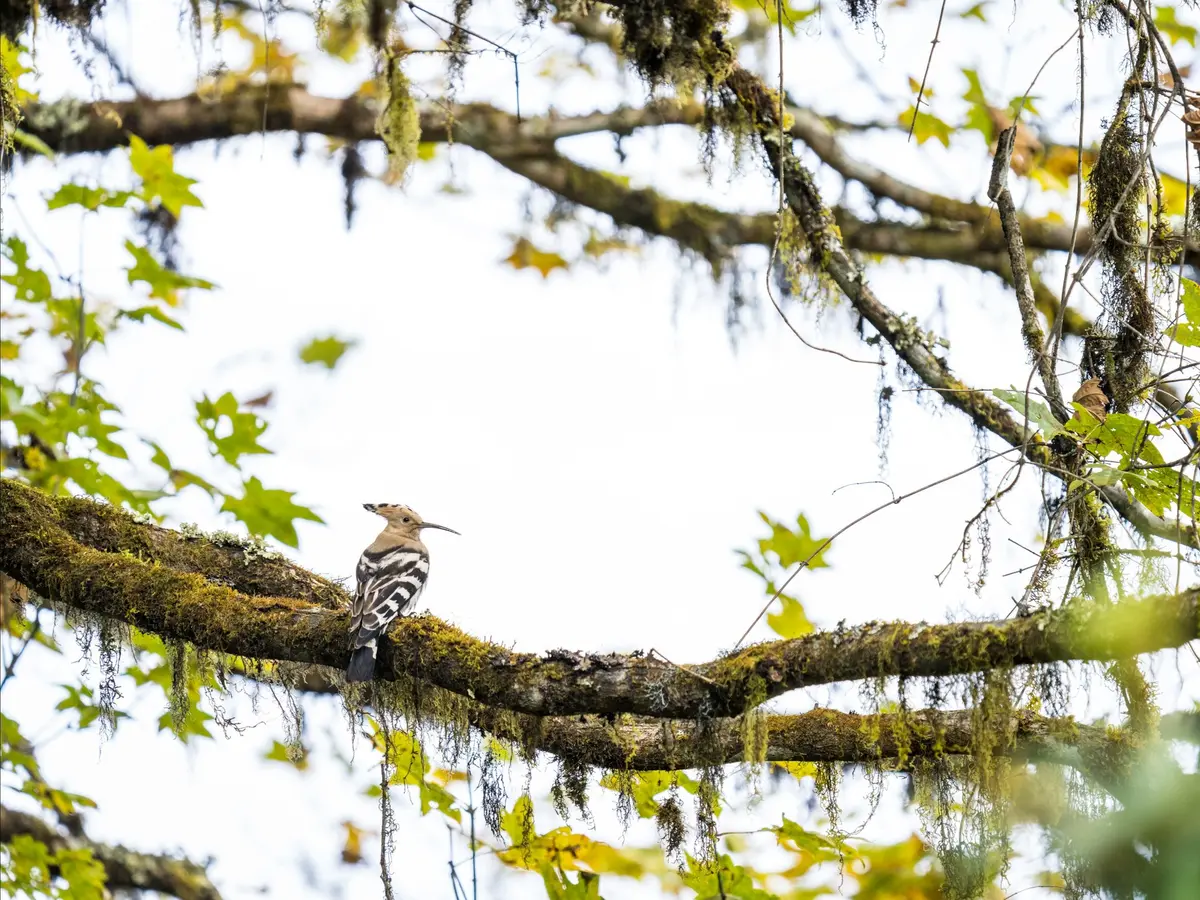
Bhutan records about 736 bird species, 30 of them globally threatened, according to the National Biodiversity Centre.
How Bhutan Protects Its Biodiversity
The 60% rule
Article 5 of the Constitution of Bhutan (2008) states that at least 60% of the country's land must be kept under forest cover "for all time." Few countries write a forest target into their constitution.
The latest National Forest Inventory, released by the Department of Forests and Park Services (DoFPS) on 31 July 2023, put forest cover at 69.7%. The same report noted that growing stock (the volume of standing timber) had fallen 20% since the 2015 inventory, so the headline cover figure does not tell the whole story.
Parks, sanctuaries and corridors
Bhutan's protected-area network includes five national parks, four wildlife sanctuaries and one strict nature reserve:
| Protected area | Type | Main districts |
|---|---|---|
| Jigme Dorji National Park | National park | Gasa, Paro, Punakha, Thimphu, Wangdue |
| Wangchuck Centennial National Park | National park | Bumthang, Gasa, Lhuentse, Trongsa, Wangdue |
| Jigme Singye Wangchuck National Park | National park | Sarpang, Tsirang, Trongsa, Wangdue, Zhemgang |
| Phrumsengla National Park | National park | Bumthang, Lhuentse, Mongar, Zhemgang |
| Royal Manas National Park | National park | Pemagatshel, Sarpang, Zhemgang |
| Bumdeling Wildlife Sanctuary | Wildlife sanctuary | Lhuentse, Mongar, Trashiyangtse |
| Sakteng Wildlife Sanctuary | Wildlife sanctuary | Trashigang, Samdrup Jongkhar |
| Jomotsangkha Wildlife Sanctuary | Wildlife sanctuary | Samdrup Jongkhar |
| Phibsoo Wildlife Sanctuary | Wildlife sanctuary | Dagana, Sarpang |
| Jigme Khesar Strict Nature Reserve | Strict nature reserve | Haa |
Source: List of protected areas of Bhutan.
These parks are joined by biological corridors, strips of forest that let animals such as tigers and elephants move between them. Together, parks and corridors cover about 51% of the country, according to the Green Climate Fund. People live inside many of the parks, and herding and farming continue under management plans, so these are not empty wilderness areas.
Bhutan also has wetlands of international importance under the Ramsar Convention. Bumdeling and Khotokha were designated in 2012, when Bhutan joined the convention (IISD), and Gangtey-Phobji, at about 975 hectares, is the largest Ramsar site in the country (Daily Bhutan).
Bhutan for Life: paying for conservation
Protecting half a country costs money that a small economy struggles to raise alone. Bhutan for Life, a project-finance-for-permanence deal backed by WWF and other partners, was set up to close that gap. The Green Climate Fund approved its US$26.6 million grant on 2 October 2017, as part of a US$118 million total package. The plan runs for about 14 years, with outside funding stepping down over time while the government's own funding of the protected areas rises, so that the system can be self-funded at the end.
How tourism contributes
Visitors also pay toward conservation through the Sustainable Development Fee (SDF), a daily charge for most international tourists. The government says the fee supports conservation, along with health, education and infrastructure. Our SDF guide explains the current rates, discounts and exemptions.
Pressures and Open Questions
Bhutan's record is strong, but its wildlife faces real pressures:
- Human–wildlife conflict. Wild pigs, monkeys, elephants and bears raid crops, and tigers and leopards sometimes kill livestock. This is one of the main concerns for rural households.
- Roads and hydropower. New roads, transmission lines and dams cut through forest and change rivers. River changes affect species such as the white-bellied heron, which needs undisturbed river stretches.
- Wetland loss. The falls in crane numbers at Bumdeling and Khotokha are linked to wetland change and human activity.
- Climate change. Warming is moving species and treelines upslope and raising the risk of glacial lake outburst floods. Our report on the Thorthormi Lake siphon test covers one of the responses.
- Poaching. Demand for musk pods, tiger parts, cordyceps and other products still drives illegal hunting and collection in parts of the Himalaya.
- Gaps in knowledge. Insects, fungi, fish and amphibians are poorly surveyed, and many counts above will change as fieldwork continues.
What It Means for Travellers
Bhutan is not a safari destination where large animals are easy to see. Forests are dense, animals are wary, and most mammals are active at night. What Bhutan offers is intact habitat, well-known sites for a few species, excellent birding, and a good chance of seeing something unusual if you spend time in the right places.
Where to go
- Phobjikha valley (Wangdue): black-necked cranes in winter, plus easy nature walks. See Phobjikha.
- Royal Manas National Park (Sarpang/Zhemgang): the country's main lowland wildlife area, with elephants, gaur, hornbills and river birding. See our Royal Manas safari.
- Dochula and the Royal Botanical Park, Lamperi: rhododendrons in spring and a chance of red panda. See our Botanical Rhododendron tour.
- Trongsa–Zhemgang road: golden langurs and broadleaf-forest birding.
- The east (Mongar, Lingmethang, Trashiyangtse): some of Bhutan's best birding, including the Monggar birding section of the Trans Bhutan Trail and the cranes of Bumdeling (Trashiyangtse).
- High treks (Jomolhari, Laya, Snowman): alpine flowers, blue sheep, marmots and, very rarely, snow leopard sign. See our trekking guide.
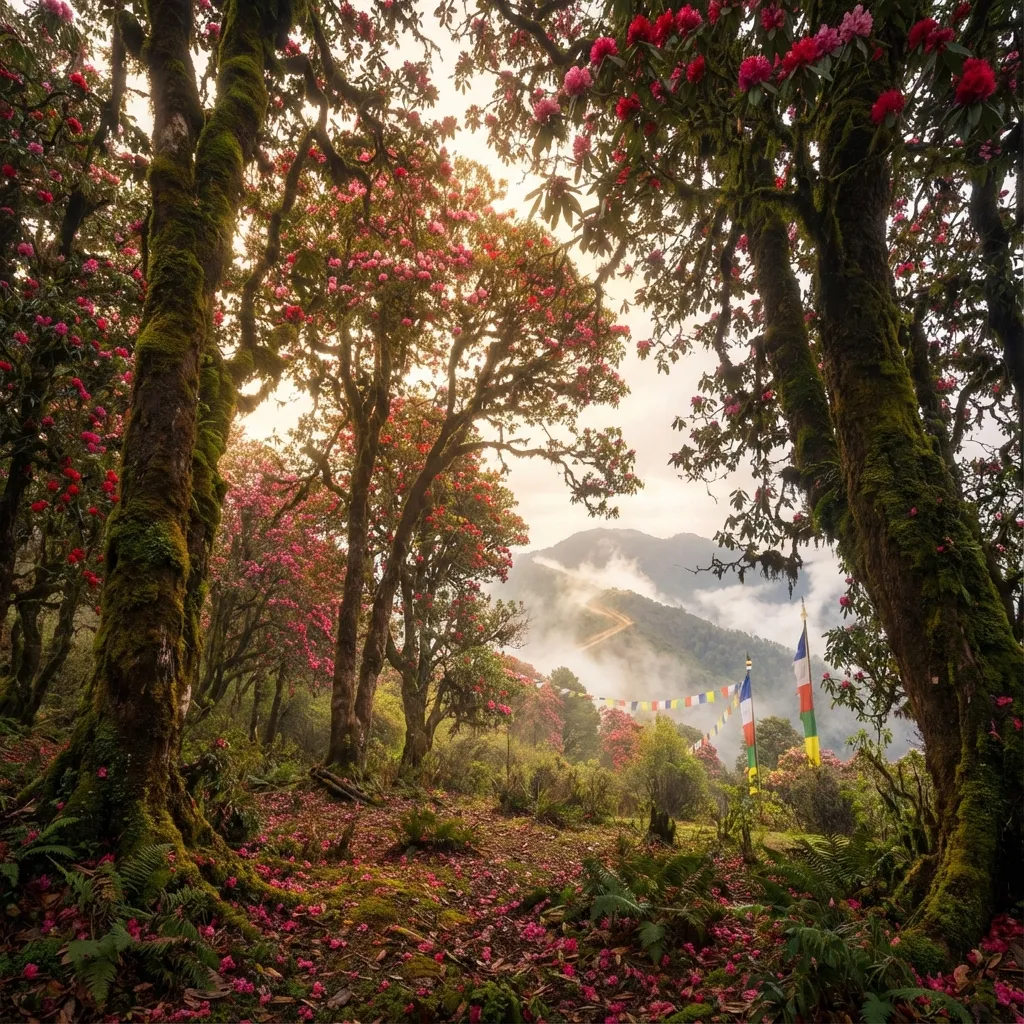
Spring rhododendron bloom. The Royal Botanical Park at Lamperi grows 46 rhododendron species.
When to go
| Interest | Best months (general guide) |
|---|---|
| Black-necked cranes | Late October to February; festival on 11 November |
| Rhododendrons and spring flowers | March to May |
| Birding (resident and breeding birds) | March to May, with a second good window October to November |
| Royal Manas and the southern lowlands | November to April (hot and wet in summer) |
| Alpine flowers on high treks | June to September (monsoon, wet trails) |
| High treks with clear views | October to November, then April to May |
For month-by-month detail, see our best time to visit guide.
Practical tips
- Book a specialist guide for birding or wildlife. General cultural guides may not know the sites or calls.
- Plan for time, not a checklist. Two nights in Phobjikha or three in Manas gives far better odds than a quick stop.
- Keep your distance from nests, roosts and crane feeding areas, and follow the marked paths in Phobjikha.
- Do not buy wildlife products, including musk, bear parts, cordyceps sold outside licensed channels, or items made from protected species.
- Bring binoculars (8x42 or 10x42 are standard) and a field guide or bird app with offline data.
- Check the visa and SDF rules before booking. Our visa guide covers the current process.
Frequently Asked Questions
Is Bhutan a biodiversity hotspot?
Yes. Bhutan is part of the Himalaya biodiversity hotspot, one of 36 recognised worldwide. To qualify, a region must have at least 1,500 endemic vascular plant species and must have lost at least 70% of its original vegetation. Bhutan has kept far more of its forest than most of the hotspot.
How many species are there in Bhutan?
According to the National Biodiversity Centre, Bhutan has more than 5,600 seed plants, about 411 ferns, 129 mammals, about 736 birds, 158 amphibians and reptiles, about 750 butterflies and about 130 fish. Counts change as new surveys add records.
How much of Bhutan is protected?
About 51% of the country is inside national parks, wildlife sanctuaries, a strict nature reserve and the biological corridors linking them. Separately, the constitution requires at least 60% of the land to stay under forest, and the 2023 inventory measured 69.7%.
How many tigers and snow leopards are in Bhutan?
The 2021–22 survey counted 131 tigers, up from 103 in 2015. The 2022–23 survey counted 134 snow leopards, up from 96 in 2016.
Where is the best place to see wildlife in Bhutan?
Phobjikha for black-necked cranes in winter, Royal Manas for lowland wildlife and birds, the Trongsa–Zhemgang road for golden langurs, and eastern Bhutan for birding. Large cats are very rarely seen.
Is Bhutan carbon negative?
Bhutan describes itself as carbon negative, meaning its forests absorb more carbon dioxide than the country emits. The 2023 forest report said carbon sequestration capacity had increased even though forest cover had dipped slightly since the previous inventory.
Sources
- CEPF, Hotspots defined and Himalaya hotspot
- National Biodiversity Centre, Species diversity
- Department of Forests and Park Services, National Forest Inventory 2023 release, 1 August 2023
- Constitution of the Kingdom of Bhutan, Article 5
- WWF, Bhutan's wild tiger population increases 27%, 29 July 2023
- WWF, Bhutan announces a 39.5% increase in snow leopard numbers, 16 September 2023
- Kuensel via Asia News Network, Bhutan's black-necked crane population increases but key habitats see decline, 19 February 2025
- BirdLife International, A Himalayan haven for the black-necked crane, 22 November 2024
- RSPN, White-bellied Heron Annual Population Survey 2026
- Green Climate Fund, FP050: Bhutan for Life
- IISD, Bhutan joins Ramsar, designates two wetlands of international importance, 2012
- Daily Bhutan, Gangtey-Phobji: a thriving haven for cranes and eco-tourism, 23 July 2025
- Wikipedia, List of protected areas of Bhutan and Royal Botanical Park, Lamperi
- BhutanWiki, Biodiversity of Bhutan (orchid estimate)
Figures change as new surveys are published. If you have more recent data from DoFPS, NBC or RSPN, please get in touch.
Want a trip built around Bhutan's wildlife, birds or spring flowers? Talk to us. We plan around habitat, season and realistic odds.