Asiatic Black Bears in Bhutan: The Viral Thimphu Rescue, Conservation & What Trekkers Should Know
By Karma Wangchuk · July 29, 2026 · 17 min read
In late October 2023, residents of Taba — a quiet suburb on Thimphu's northern edge — woke to an unusual visitor. A young Asiatic black bear had wandered down from the forested slopes above the capital and was moving through the neighbourhood, frightened and disoriented, with a discarded tin container stuck on its head.
Phones came out. Within hours, the footage was everywhere on Bhutanese social media: the bear, the gathering crowd kept carefully back, and finally the forest officials from the Department of Forests and Park Services who tranquillised the young animal, freed its head, and returned it to the forest. No one was hurt — including the bear.
Years later, the videos still circulate, and searches for the Bhutan bear rescue spike every time they resurface. It is easy to see why: the story has everything — danger, comedy, compassion, and a happy ending. But the viral moment is also a window into something much bigger. Bhutan is one of the last strongholds of the Asiatic black bear, a globally threatened species; encounters between bears and people are quietly increasing across the kingdom; and in 2023 Bhutan launched a formal ten-year plan to protect the animal Bhutanese call dom.
This is the full story — the rescue, the science, the conflict, the conservation — and, because most of our readers are planning a trip here, an honest guide to what bears mean for travellers and trekkers in Bhutan.
The Thimphu Bear Rescue: What Actually Happened
The Taba incident followed a pattern wildlife officials know well. It was autumn — the season biologists call hyperphagia, when bears eat almost around the clock to build fat before winter. Food-driven and still young enough to make bad decisions, the bear had followed its nose downhill from the forests above the Thimphu valley and into the edge of the city, where it found garbage — and, somewhere along the way, wedged its head into a discarded plastic container.
What happened next is the part worth dwelling on. Residents raised the alarm but largely kept their distance. Forest officials arrived, managed the crowd, sedated the animal safely, removed the container, checked the bear over, and released it back into suitable habitat. The whole operation played out in daylight, on camera, without harm to a single person or the animal.
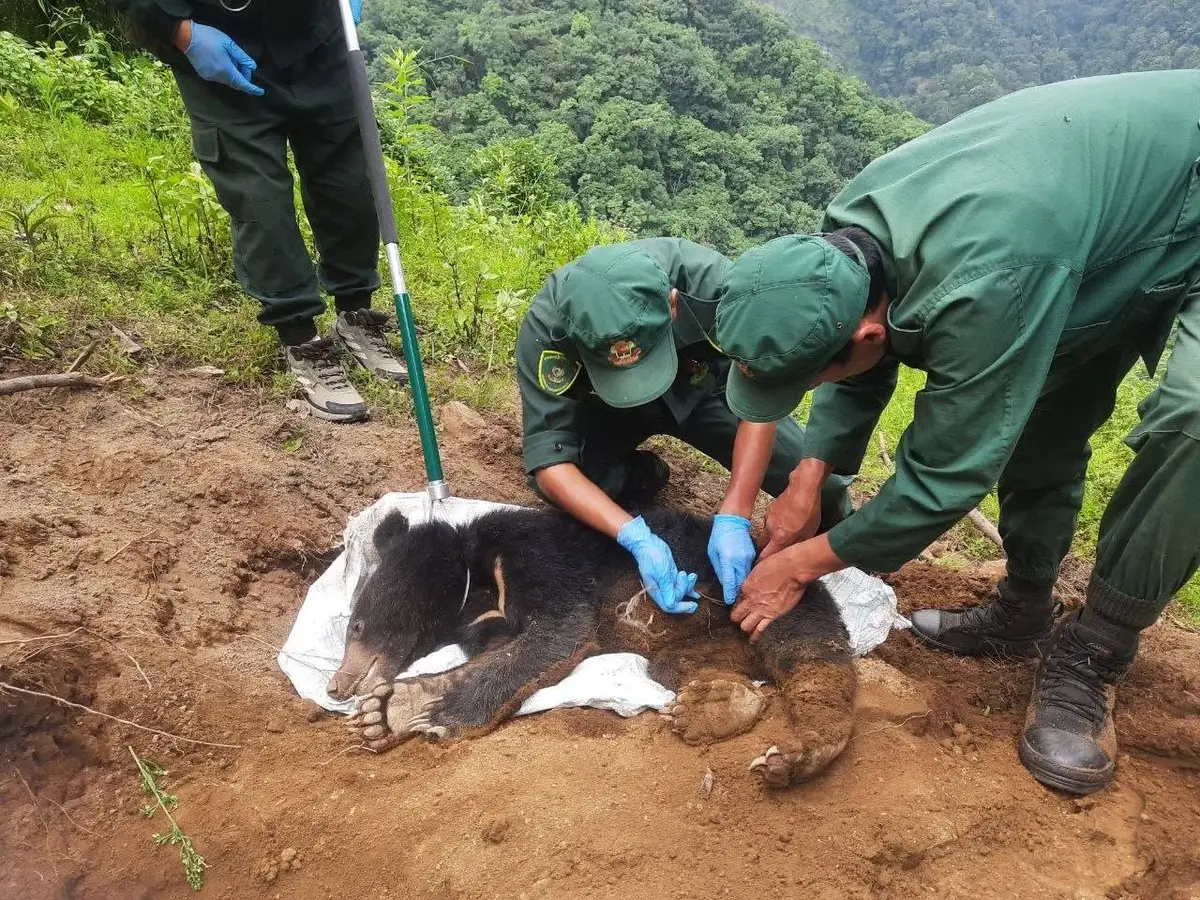
Photographs from the operation show the rescue team working over the sedated youngster on a hillside above the valley — gloved, methodical, jab-pole set aside — with the bear's cream chest crescent, the marking that gives the moon bear its name, clearly visible against the black fur. It is about as close as most people will ever safely get to a wild dom, and a rare look at how much quiet professionalism sits behind a thirty-second viral clip.
That outcome is not luck — it reflects both official capacity and something deeper in Bhutanese culture. In a Buddhist kingdom where the constitution itself mandates environmental protection, a frightened bear in the street is treated as a rescue, not a threat to be eliminated. It is the same instinct that has made Bhutan one of the very few countries on earth with no bear bile farming industry — a trade that torments thousands of Asiatic black bears elsewhere in Asia and remains one of the species' greatest threats.
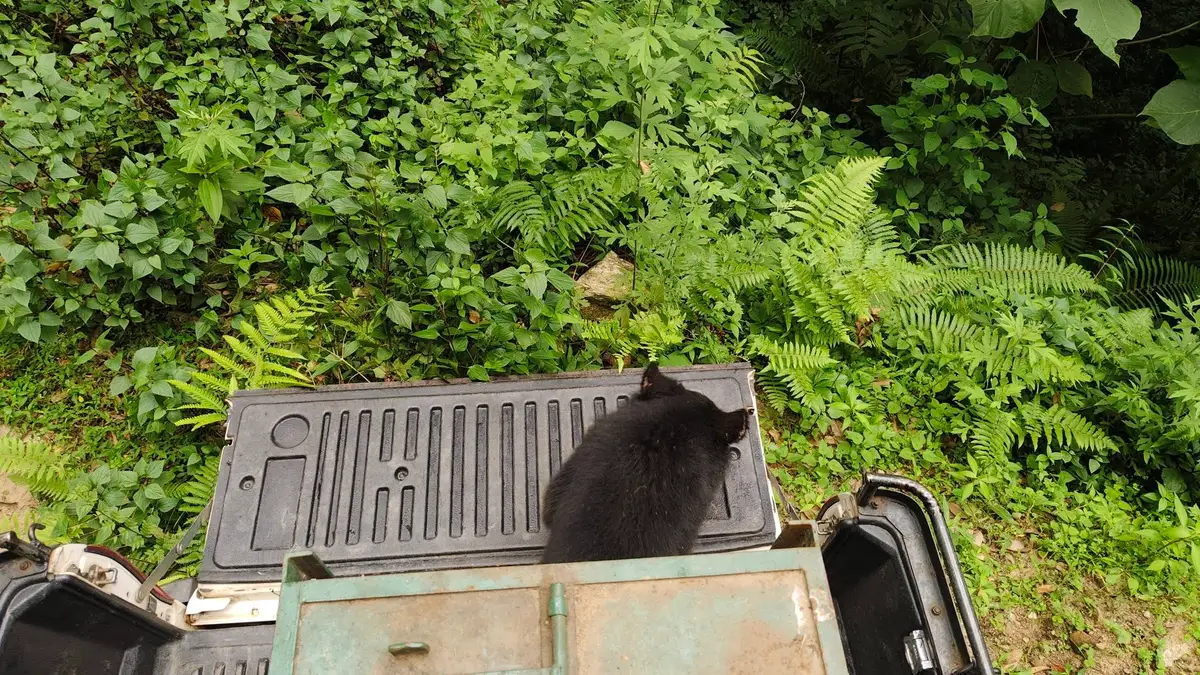
The final frame of the story is the best one. Driven back up into suitable forest, the transport cage on the forestry pickup is opened — and the young bear steps out onto the tailgate, pauses for a heartbeat above a wall of ferns and monsoon-green undergrowth, and is gone. No collar of tin, no crowd, no city. The can-on-the-head bear survived its brush with urban life. Most viral wildlife stories end worse.
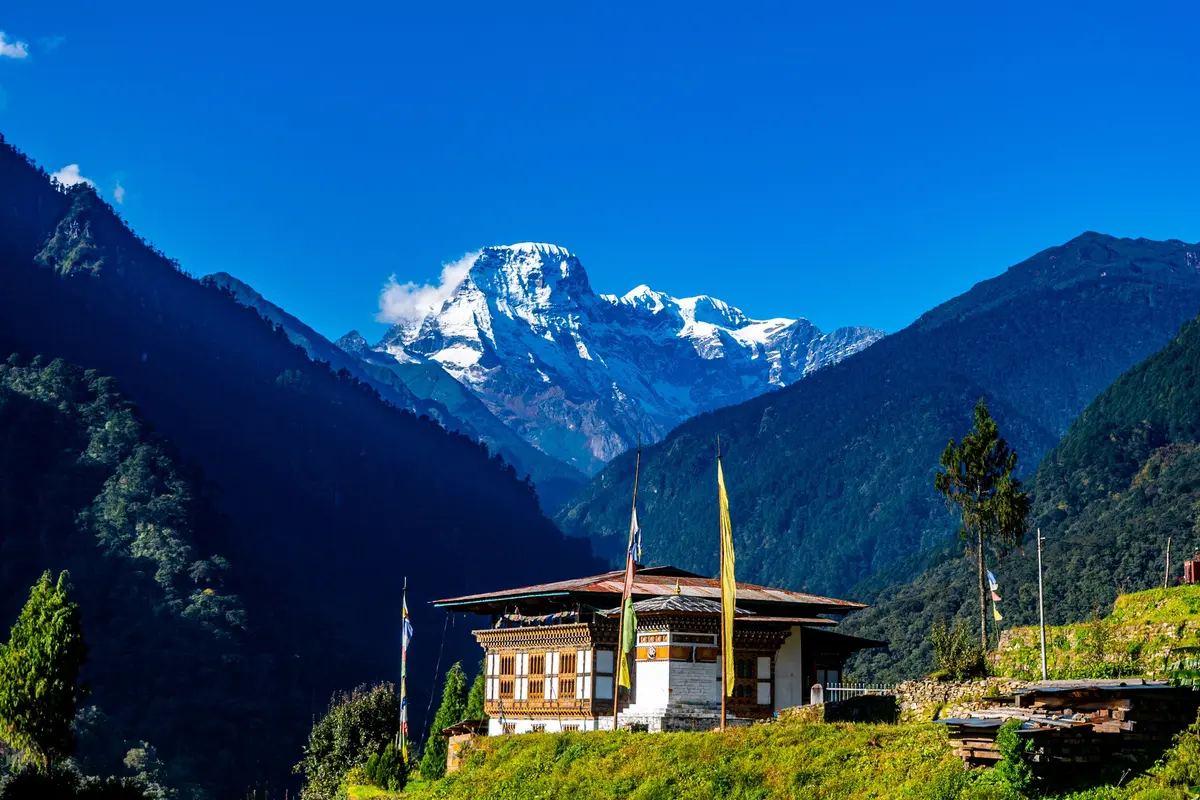
Meet the Dom: The Asiatic Black Bear
The Asiatic black bear (Ursus thibetanus) — also called the moon bear for the cream-coloured crescent across its chest, or the Himalayan black bear in this region — is a stocky, forest-dwelling bear found in a broad arc from Iran to Japan. It is listed as Vulnerable on the IUCN Red List and protected under CITES Appendix I, with populations declining across most of its range due to habitat loss, poaching for the illegal wildlife trade, and conflict with people.
Quick species profile:
| Trait | Detail |
|---|---|
| Dzongkha name | Dom |
| Size | 90–200 kg; males considerably larger than females |
| Identifier | Cream/white crescent "moon" on the chest, large rounded ears |
| Diet | Overwhelmingly plants — acorns, fruit, bamboo shoots, insects; opportunistic crops and occasionally livestock |
| Habitat in Bhutan | Broadleaf and mixed conifer forest, roughly 1,000–4,000 m |
| Behaviour | Shy, mostly solitary, excellent climber; largely avoids humans |
| Winter | Dens up at higher elevations; may stay partly active in warmer areas |
| Status | IUCN Vulnerable, CITES Appendix I, protected under Bhutanese law |
Bhutan matters disproportionately to this species. With more than 70% of the country under forest — and a constitutional requirement that forest cover never fall below 60% — Bhutan offers something the moon bear has lost almost everywhere else: large, connected, genuinely wild forest. Bears here move through an intact chain of national parks and biological corridors, from the subtropical south to the treeline. The southern foothills even host occasional records of a second species, the sloth bear, making Bhutan one of the few places where the two overlap.
Why Are Bears Wandering into Bhutanese Towns?
The Taba bear was not an isolated case. Kuensel, Bhutan's national newspaper, has documented bears "on the prowl" near settlements with growing frequency — young bears in Thimphu's fringes, crop raids in the east, encounters on farm roads at dawn. If Bhutan's forests are so healthy, why are bears turning up among people?
Wildlife officials and researchers point to a convergence of ordinary causes:
1. Autumn hyperphagia. Most town encounters happen in autumn, when bears must gain enormous weight fast. A failed acorn year in the forest sends them searching — and downhill smells like food.
2. Unsecured waste and crops. Garbage, fruit orchards, beehives, and above all ripening maize are irresistible, calorie-dense targets. A bear that finds food near people once will remember.
3. Settlements expanding into the forest edge. Thimphu's suburbs — Taba among them — climb directly into prime bear habitat. The bears haven't moved toward the city; the city has moved toward the bears.
4. Young, dispersing bears. Like the Taba visitor, most urban wanderers are juveniles pushed out of their mothers' ranges and still learning where not to go.
The result is what conservationists call human-bear conflict, and it cuts both ways: crop and livestock losses for farming families who can least afford them, occasional maulings of villagers surprised at close range — and retaliation, snares, and fear directed back at the bears. Research in buffer zones such as the Jigme Khesar Strict Nature Reserve confirms what the headlines suggest: the bear is widely feared and disliked in rural Bhutan, and reducing that conflict is now the heart of the conservation challenge.
The 2023–2033 Conservation Action Plan
That challenge is exactly what Bhutan's Asiatic Black Bear Conservation Action Plan (2023–2033) was written to meet. Launched by the Department of Forests and Park Services with support from the Bhutan For Life conservation fund, it is one of the first dedicated national bear plans in the region. Its priorities read like a direct response to the Taba story:
- Count the bears. Bhutan has never had a reliable national population estimate; the plan calls for systematic camera-trap and sign surveys to establish a baseline.
- Reduce human-bear conflict. Better waste management at the forest edge, electric fencing and bear-proofing for crops and hives, compensation and insurance schemes for losses, and rapid-response teams like the one that handled Taba.
- Fight snares and the illegal trade. Poaching for bile, paws, and skins remains the moon bear's most brutal threat across Asia; the plan strengthens anti-snare patrolling and transboundary enforcement.
- Change the story. Education campaigns to shift the dom's reputation from feared crop-raider to national conservation asset — the same social transformation Bhutan achieved for the tiger and the black-necked crane.
The regional context makes this timely. Just across the border in Assam, rescued moon bear cubs made international news in June 2026 when they were rehabilitated and released into the wild — part of a slow, hopeful shift in how South Asia treats a species it once knew mostly as a commodity.
Bears and Trekkers: The Honest Risk Assessment
Here is the question our guests actually ask: will I meet a bear on my trek, and should I worry?
The honest answer: an encounter is unlikely, and an incident is genuinely rare. Asiatic black bears are shy forest animals that overwhelmingly avoid people. Bhutanese trekking routes — the Druk Path, Jomolhari, Bumdra, and the rest — are walked by groups with guides, mules, and conversation, which is precisely the noise profile bears leave alone. In fifteen years of guiding, the bears I've seen have all been distant, briefly glimpsed, and leaving. Virtually every serious incident in Bhutan involves a villager surprising a bear at close range in dense vegetation or a maize field at dawn or dusk — not a trekking group on an open trail.
That said, you are walking through bear country, and sensible habits cost nothing:
On the trail:
- Stay with your group and your guide — Bhutan's mandatory guiding rules are, among other things, a wildlife-safety system
- Make natural noise in dense forest and around blind corners, especially near streams that mask sound
- Be most alert at dawn and dusk in autumn (the hyperphagia months of September–November)
- Never approach or follow a bear for a photo — and never, ever go near a cub, because its mother is closer than you think
In camp:
- Keep food, snacks, and scented items out of your tent — your trekking crew's kitchen-tent discipline exists for a reason
- Pack out or properly secure all waste; a food-conditioned bear is a doomed bear
If you do meet one at close range:
- Do not run, and do not climb a tree (they climb better)
- Group together, speak calmly and firmly, and back away slowly at an angle
- Give it an exit route — nearly every bear takes it immediately
Perspective matters: your objective risks in the Himalaya are altitude, weather, and road travel, in that order. The bear belongs far down the list — closer to the takin than to the avalanche.
Where to Experience Bhutan's Wildlife (Ethically)
You should not go looking for black bears — for their sake and yours. But if the Taba video is what brought you here, Bhutan will more than satisfy the instinct behind the click. This is one of the world's ten biodiversity hotspots, with wildlife experiences that are legitimate, ethical, and spectacular:
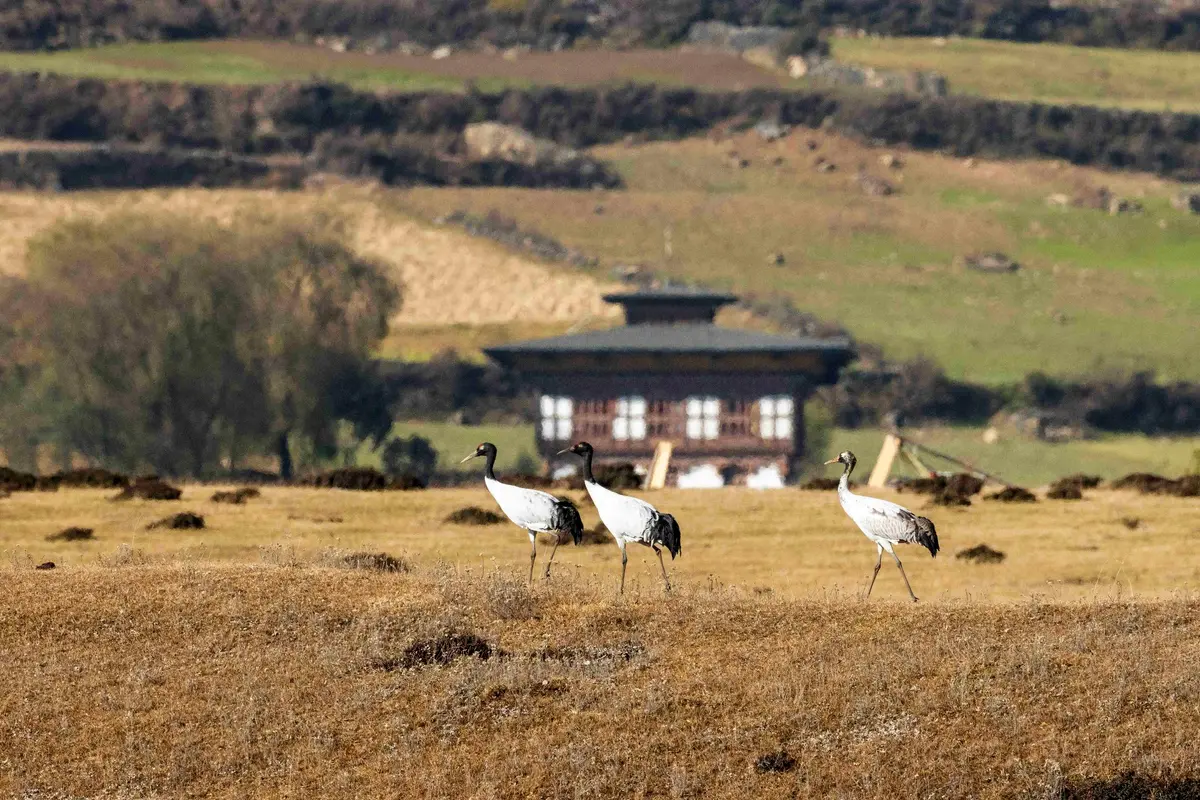
- Black-necked cranes in Phobjikha (late October–mid February) — the kingdom's flagship conservation story, watched from the valley-floor observation centre
- The Motithang Takin Preserve, Thimphu — home of Bhutan's wonderfully improbable national animal, an easy add-on to any capital day
- Birding across elevations — 700+ recorded species, from hornbills in the southern foothills to Himalayan monals near the passes
- Jigme Dorji National Park on the Jomolhari trekking routes — takin, blue sheep, marmots, and if you are extraordinarily lucky, snow leopard tracks
- Royal Manas National Park in the south — Bhutan's oldest park, with elephants, golden langurs, and yes, both bear species in forests you'll never need to test
Our nature and wildlife tours are built around these experiences, with guides trained to find animals without harassing them. For the landscape behind the biodiversity, see our guide to Bhutan's extraordinary Himalayan geography.
The Bigger Picture: Why Bhutan Is the Moon Bear's Best Hope
Zoom out from one bear with a can on its head, and the numbers tell a remarkable story. Bhutan is carbon negative, keeps more than half its territory under formal protection (national parks, sanctuaries, and the biological corridors that stitch them together), and wrote a minimum-60%-forest guarantee into its constitution. Its conservation record — tigers now photographed at over 4,000 metres, snow leopard numbers rising, cranes returning each winter to valleys that treat their arrival as a festival — rests on a philosophy in which Gross National Happiness explicitly includes the wellbeing of the natural world.
The Asiatic black bear is the next test of that model. It is harder to love than a crane: it raids the maize of subsistence farmers and occasionally hurts people. Whether Bhutan can protect a genuinely inconvenient animal — with fences and insurance and rescue teams rather than snares — will say more about the future of Himalayan wildlife than any viral video.
The early evidence, from a suburb called Taba, is encouraging: a frightened young bear walked into the capital city of a nation of farmers, and walked out unharmed.
Frequently Asked Questions
Are there bears in Bhutan?
Yes — the Asiatic black bear (moon bear) is found across Bhutan's forests from roughly 1,000 to 4,000 metres, and sloth bears are occasionally recorded in the southern lowlands. Healthy forest cover makes Bhutan one of the species' most important strongholds.
What happened in the viral Bhutan bear rescue video?
In October 2023, a young Asiatic black bear with a tin container stuck on its head wandered into Taba, a northern suburb of Thimphu. Forest officials tranquillised it, freed its head, and released it back into the forest unharmed. The footage still recirculates regularly — which is likely how you found this article.
Are bear attacks common in Bhutan?
No. Incidents are rare and almost always involve villagers surprising bears at close range in fields or dense forest — not tourists. No trekking group with a licensed guide should consider bears a significant risk, though standard bear-country habits (noise, no food in tents, never approach) always apply.
Do Asiatic black bears hibernate in Bhutan?
At higher, colder elevations bears den through the winter; in Bhutan's warmer mid-elevations they may remain partly active. The riskiest season for encounters is actually autumn, when pre-winter feeding drives them furthest in search of food.
Is the moon bear the same as the Himalayan black bear?
Yes — both are common names for Ursus thibetanus, the Asiatic black bear. "Moon bear" refers to the pale crescent on its chest; the Himalayan black bear is the regional subspecies found in Bhutan.
What is Bhutan's national animal — is it the bear?
No, it's the takin — a goat-antelope so odd that legend credits its creation to the Divine Madman. You can meet takins at the Motithang preserve in Thimphu, a short drive from where the Taba bear made its famous appearance.
Can I see black bears on a Bhutan tour?
Sightings are possible but never promised — and no ethical operator baits or tracks bears. Choose a nature-focused itinerary through prime habitat like Jigme Dorji or Royal Manas and treat any distant glimpse as the jackpot it is.
Final Thought
The best wildlife stories are the ones where everyone walks away — the bear to its forest, the villagers to their morning, the officials to the next call. Bhutan produces those endings more reliably than almost anywhere, because it decided, constitutionally and culturally, that the forest and its animals are not the backdrop of the country. They are the country.
Come see it. Leave the bears their distance, bring binoculars for the cranes, and trust that somewhere on the slopes above the trail, a dom with a faint crescent moon on its chest is minding its own business — exactly as it should be.
Planning a wildlife-focused journey? Explore our nature and wildlife tours, start with the complete trekking guide, or talk to our team about timing your trip for cranes, birds, and the wild valleys in between.