Bhutan's Ghost Deer Steps Into the Frame: First Photographic Record of the Himalayan Musk Deer in Tsirang
By Best of Bhutan Research Desk · August 5, 2026 · 11 min read
Bhutan has just added a line to its natural history. In early August 2026, Kuensel reported that a camera trap in south-central Tsirang recorded the first photographic evidence of the Himalayan musk deer (Moschus leucogaster) in the district — an endangered, famously elusive animal that most Bhutanese foresters go an entire career without seeing in the flesh.
The image was captured at roughly 2,200 metres above sea level, which is the part of the story biologists find most interesting. It sits below where this species is normally expected to live, and it happened in one of the few dzongkhags in Bhutan with no protected area within its boundaries.
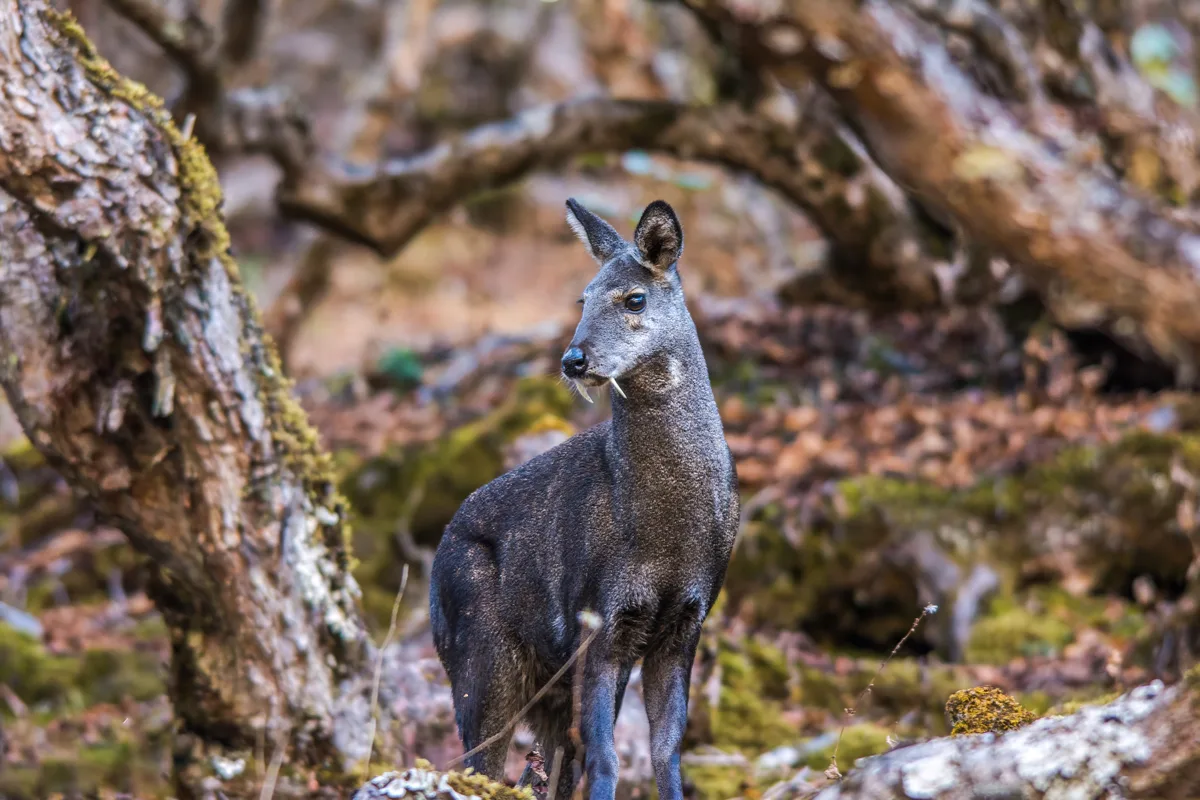
Himalayan musk deer photographed in Himalayan forest habitat. Photo: Gurung Pratap, CC BY-SA 4.0, via Wikimedia Commons. This is a representative image of the species, not the Tsirang camera-trap photograph — that image belongs to the survey team and was published by Kuensel.

Key Facts at a Glance
| Detail | What was recorded |
|---|---|
| Species | Himalayan musk deer (Moschus leucogaster) |
| Location | Southern central Tsirang, south-central Bhutan |
| Elevation | ~2,200 m above sea level |
| Significance | First photographic record for the district; extends known lower elevation range |
| Conservation status | Endangered (IUCN Red List) |
| Legal protection | Schedule I, totally protected — Forest and Nature Conservation Act of Bhutan |
| International trade | CITES Appendix I (Appendix II for Chinese populations) |
| Reported by | Kuensel, August 5, 2026 |
Why a Single Photograph Matters
For most travellers, a blurry nocturnal image of a shy forest animal is easy to scroll past. For conservation science, it is the difference between belief and record.
Musk deer are solitary, mostly crepuscular, and vanish at the first hint of a human being. They do not herd, they do not graze in the open, and they leave little sign beyond droppings and browse marks that are hard to attribute with confidence. Across much of their range, "presence" has historically rested on interviews with herders and hunters, or on confiscated musk pods — evidence that tells you an animal was somewhere, once, but not that a living population persists.
A dated, geolocated photograph changes the category of the claim. It gives the Department of Forests and Parks Services a defensible data point for range maps, and it gives future surveys a place to start.
The elevation is the headline
Himalayan musk deer are typically associated with subalpine and alpine forest above roughly 2,500 metres, often much higher, in birch, rhododendron, fir and juniper habitat near the treeline. A confirmed record at around 2,200 metres pushes the known lower boundary down.
There are two plausible readings, and honest reporting requires holding both:
- The species uses lower forest than we assumed — either seasonally, or in places where dense, undisturbed temperate broadleaf and conifer forest offers the cover it needs.
- We have simply never looked properly at these elevations. Camera-trap effort in the Himalaya has concentrated on high-altitude flagship species — snow leopard, takin, blue sheep — and on protected areas. Absence of records is not the same as absence of animals.
Either way, the practical conclusion is the same: mid-elevation forests in southern Bhutan deserve more survey effort than they have received.
The Tsirang Angle: A Discovery Outside the Park System
Bhutan protects a famously large share of its territory. More than half the country sits inside national parks, wildlife sanctuaries, and the biological corridors that stitch them together, and the constitution requires at least 60% forest cover in perpetuity.
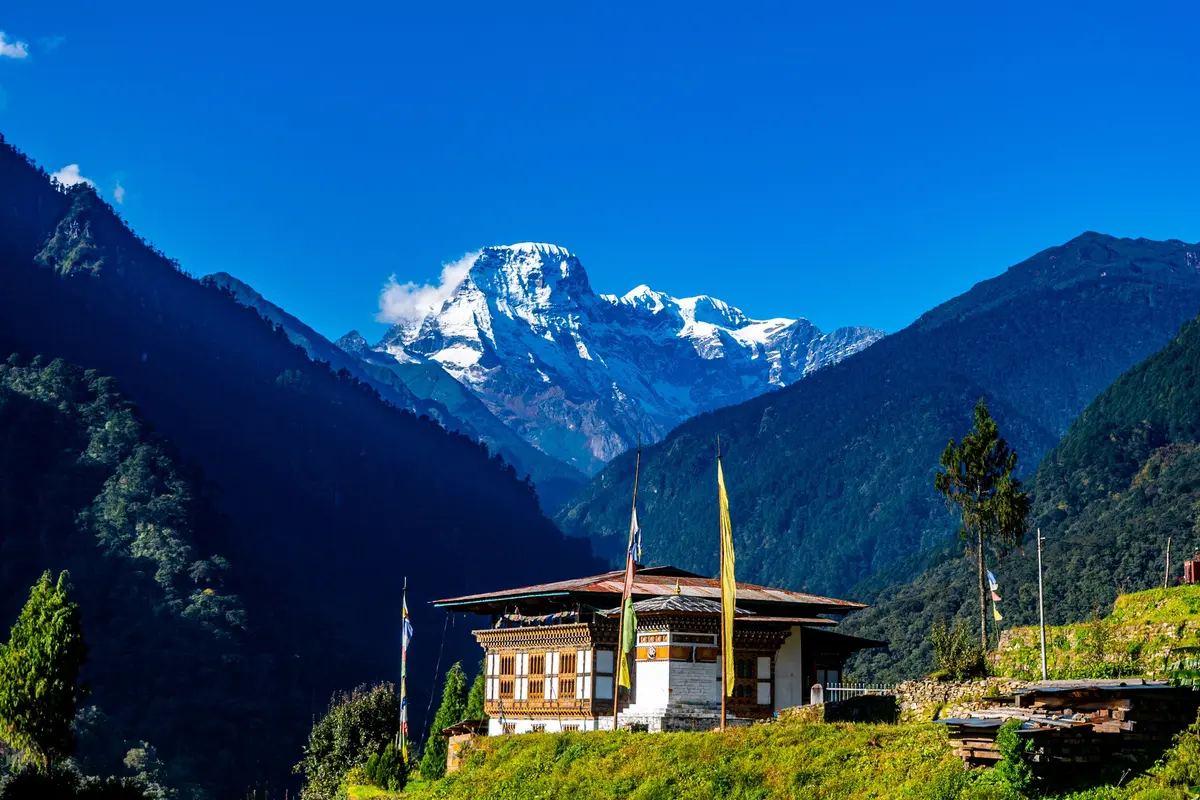
Tsirang is one of the few dzongkhags without a protected area inside it. It is a gentle, agricultural district of terraced hillsides and mild climate, best known within Bhutan as the country's organic farming heartland, threaded by the Punatsang Chhu (Sankosh) river on its way south to India.
That is precisely what makes this record valuable. It is evidence that endangered wildlife is not confined to the map's green polygons — that ordinary working landscapes, farmed and lived in, still hold species of global conservation concern. Bhutan's biological corridors were designed on exactly this premise: that animals move through the spaces between parks, and those spaces have to stay permeable.
Meet the Himalayan Musk Deer
The musk deer is one of the strangest and most misunderstood animals in the Himalaya.
It is not really a deer. Musk deer belong to their own family, Moschidae, an ancient lineage that split from true deer (Cervidae) long ago. They are small — roughly 60 centimetres at the shoulder and 11–18 kg — with disproportionately large hind legs that give them a rabbit-like bounding gait on steep ground.
Males grow tusks, not antlers. No musk deer of either sex grows antlers. Instead, males develop elongated upper canine teeth that curve down past the chin, sometimes 7–10 centimetres long, used in fights over territory and mates. In a Himalayan forest, a small hunched deer-like animal with visible fangs is a musk deer and nothing else.
They are solitary and territorial, marking ground with secretions and dung piles, browsing on leaves, lichens, mosses, and forbs.
Bhutan has two musk deer species
Bhutan is home to both the Himalayan musk deer (Moschus leucogaster) and the Alpine musk deer (Moschus chrysogaster). Distinguishing the two in the field — and in camera-trap images — is genuinely difficult, which is one reason expert verification of records like the Tsirang photograph matters.
The Musk Pod: Why This Animal Is Hunted
Every threat facing this species traces back to a gland the size of a golf ball.
Adult males possess a musk pod — a sac between the navel and genitals producing a waxy secretion used to attract mates. For at least fifteen centuries, that substance has been prized in perfumery and traditional medicine across Asia. Gram for gram, natural musk has at times been among the most valuable animal products in the world, exceeding the price of gold.
The consequences are exactly what economics predicts. Poaching has driven Himalayan musk deer populations down dramatically — by some estimates to roughly half their historic numbers over the past two decades. Snares are the usual method, and they are indiscriminate: they kill females and young, which carry no musk at all, alongside the males being targeted.
Secondary pressures compound the problem: habitat fragmentation, intensive livestock grazing that degrades understory browse, fuelwood cutting, road construction, and hydropower development.
Modern perfumery has largely moved to synthetic musks, which are cheaper, more consistent, and involve no dead deer. The demand that persists is driven by traditional medicine markets and by the belief that "natural" musk is superior — a belief with no pharmacological support and a very high body count.
What Bhutan Does Differently
Bhutan's record on wildlife protection is unusually strong, and it rests on three pillars that reinforce one another.
Law. The musk deer is a Schedule I species under the Forest and Nature Conservation Act — the country's highest protection category, prohibiting killing, capture, or injury outright.
Landscape. A protected-area network covering over half the country, joined by biological corridors, means wildlife has room to move. The constitutional 60% forest floor is not aspirational language; it is a binding constraint on development.
Culture. Buddhist prohibitions on taking life are not merely decorative in Bhutan. They translate into genuine community reluctance to hunt, and into local tolerance for wildlife that would be intolerable in many places — a factor conservation scientists consistently identify as central to Bhutan's success.
The result is a country that remains carbon-negative, keeps tigers and snow leopards in the same national park, and periodically turns up species that neighbouring countries have lost. For the fuller picture of how this philosophy shapes national policy, see our explainer on Gross National Happiness.
Can Travellers See a Musk Deer in Bhutan?
Honestly? Almost certainly not — and that is worth saying plainly rather than selling a fantasy.
Musk deer are nocturnal-to-crepuscular, solitary, live in steep forested terrain, and flee human presence long before you register theirs. Bhutanese forest officers who spend their working lives in these landscapes count sightings on one hand. Any tour promising a musk deer sighting is selling something it cannot deliver.
What Bhutan can deliver is world-class wildlife experience of a different kind:
- Black-necked cranes in the Phobjikha valley from late October to February — a genuine spectacle with a near-guarantee of sightings, and the subject of its own festival
- Golden langurs, endemic to a small area of Bhutan and India, reliably seen in the central-south forests on our Golden Langur Trail
- Red pandas in the Gasa forests — difficult, but not impossible, on the Red Panda Trail
- Royal Manas National Park, Bhutan's oldest and most biodiverse, with elephants, gaur, and (very rarely) tigers, on our Manas safari
- Over 700 bird species, including several Himalayan endemics, on the Bird Watching Paradise itinerary
The honest framing is the one Bhutan itself uses: you come here for intact habitat and the chance of an encounter, not a guaranteed checklist. If you want to understand what living alongside large wildlife actually looks like here, read our account of the Asiatic black bear rescue.
What Should Happen Next
Conservation biologists reading this record would likely propose the same sequence:
- Expanded camera-trap effort across mid-elevation forests in Tsirang and neighbouring Dagana, Sarpang, and Zhemgang — designed for musk deer detection rather than treating them as bycatch of tiger surveys.
- Genetic confirmation to establish species identity beyond doubt, given the difficulty of separating M. leucogaster from M. chrysogaster visually.
- Snare sweeps and patrol prioritisation in the surrounding forest. A confirmed population is also a confirmed poaching target, and publicity cuts both ways.
- Community engagement with Tsirang's farming communities, who share this landscape and whose cooperation determines whether the population persists.
- Peer-reviewed publication, which converts a news item into a citable range extension that future researchers can build on.
Frequently Asked Questions
What is the Himalayan musk deer?
A small, solitary, endangered mammal of Himalayan forests — not a true deer, but a member of the family Moschidae. Males grow long downward-curving tusks instead of antlers and possess a musk gland that has made the species a poaching target for centuries.
Why is the Tsirang record significant?
It is the first photographic evidence of the species in that district, and at approximately 2,200 metres it extends the species' known lower elevation range. It also documents an endangered species living outside Bhutan's protected-area network.
Is the Himalayan musk deer endangered?
Yes. The IUCN Red List classifies Moschus leucogaster as Endangered, and international commercial trade is prohibited under CITES Appendix I. In Bhutan it is a Schedule I totally protected species.
Why are musk deer hunted?
For the musk pod produced by adult males, used in perfumery and traditional medicine. Natural musk has historically been worth more than its weight in gold, which drives poaching even inside protected areas.
Where can I see wildlife in Bhutan as a tourist?
Phobjikha valley for black-necked cranes in winter, Royal Manas National Park for lowland megafauna, the central-south forests for golden langurs, and Gasa for red pandas. Musk deer sightings are effectively impossible to plan for.
How much of Bhutan is protected?
More than half the country lies within protected areas and biological corridors, and the constitution mandates a minimum of 60% forest cover in perpetuity — one of the strongest such provisions anywhere.
Sources and Credits
This article is reported from the following sources, with thanks to the journalists and researchers whose work made it possible:
- Kuensel — "Tsirang records first photographic evidence of Himalayan musk deer," August 5, 2026. Bhutan's national newspaper broke this story; the camera-trap photograph belongs to the survey team and is published there.
- IUCN Red List of Threatened Species — conservation assessment for Moschus leucogaster
- CITES — Appendix I listing for musk deer outside China
- Forest and Nature Conservation Act of Bhutan — Schedule I totally protected species
- Department of Forests and Parks Services, Bhutan — national camera-trapping programme, which between 2014 and 2015 deployed 1,858 camera traps across 1,129 grid cells from 150 m to 4,500 m elevation
- Species biology drawn from peer-reviewed literature on Moschus ecology, including work published in Scientific Reports, Global Ecology and Conservation, and Oryx
- Header photograph: Gurung Pratap, CC BY-SA 4.0, via Wikimedia Commons — a representative image of the species, not the Tsirang record
Corrections and additional detail are welcome — if you were involved in the survey and would like the record here expanded or amended, please get in touch.
Travelling to Bhutan and want your itinerary built around forests, birds, and genuine wild country rather than a checklist? Talk to us — we plan around habitat, season, and the realistic odds of what you'll actually see.