108 Fascinating Facts About Bhutan: The Dragon Kingdom, By the Sacred Number
By Best of Bhutan Research Desk · July 29, 2026 · 25 min read
Why 108 facts, and not a round 100? Because in Bhutan, 108 is the number that matters. Buddhist prayer beads carry 108 beads, one for each of the defilements to be overcome. The great 7th-century king Songtsen Gampo is said to have built 108 temples across the Himalaya in a single campaign — and two of them still stand in Bhutan today. And when you drive east out of Thimphu, the Dochula Pass greets you with exactly 108 memorial chortens rising out of the mist.
So here they are: 108 verified facts about Bhutan — the kings and queens, the thunder dragon on the flag, the happiness index that replaced GDP, the mountain no human has ever climbed, and the fried chillies that aren't a spice but a vegetable. Every fact checked, every rabbit hole linked. Settle in.
The Kingdom and Its Name
1. Bhutan's real name is Druk Yul — "Land of the Thunder Dragon." The name comes from the Drukpa school of Buddhism, whose founding is linked to the sound of thunder — believed to be the voice of a dragon — over a Tibetan valley. Bhutanese people call themselves Drukpa, the dragon people.
2. Bhutan has never been colonized. Through five centuries that saw every one of its neighbours fall under foreign rule, the kingdom repelled invasions, negotiated shrewdly with the British Empire, and kept its sovereignty unbroken — one reason its culture survives so intact.
3. It is roughly the size of Switzerland — with a fraction of the people. About 38,394 square kilometres of territory hold under 800,000 citizens, making Bhutan one of the least crowded countries in Asia.
4. It borders exactly two countries — and they happen to be giants. Bhutan is wedged entirely between China (Tibet) to the north and India on every other side, one of the very few nations on earth sandwiched between two superpowers and nothing else.
5. Bhutan only joined the United Nations in 1971. For most of the 20th century the kingdom stayed deliberately outside world affairs; UN membership was its formal step onto the global stage.
6. It has no formal diplomatic relations with any permanent UN Security Council member. No embassy exchange with the United States, China, Russia, the UK, or France — a quiet neutrality almost no other country maintains. Its closest partner is India.
7. The monarchy is young — it began on 17 December 1907. Ugyen Wangchuck, the governor of Trongsa, was unanimously elected Bhutan's first hereditary king by an assembly of monks, officials, and people. December 17 is still celebrated as National Day.
8. Democracy came because the King insisted on it — over his people's objections. In one of history's rare voluntary handovers of royal power, the Fourth King ordered the drafting of a constitution and the first democratic elections, held in 2008. Many Bhutanese marched to ask him not to.
9. The name "Bhutan" likely comes from outside. Scholars trace it to Sanskrit — perhaps Bhu-uttan, "highlands," or Bhotanta, "the end of Tibet." Inside the country, it has always been Druk Yul.
The Royal Family
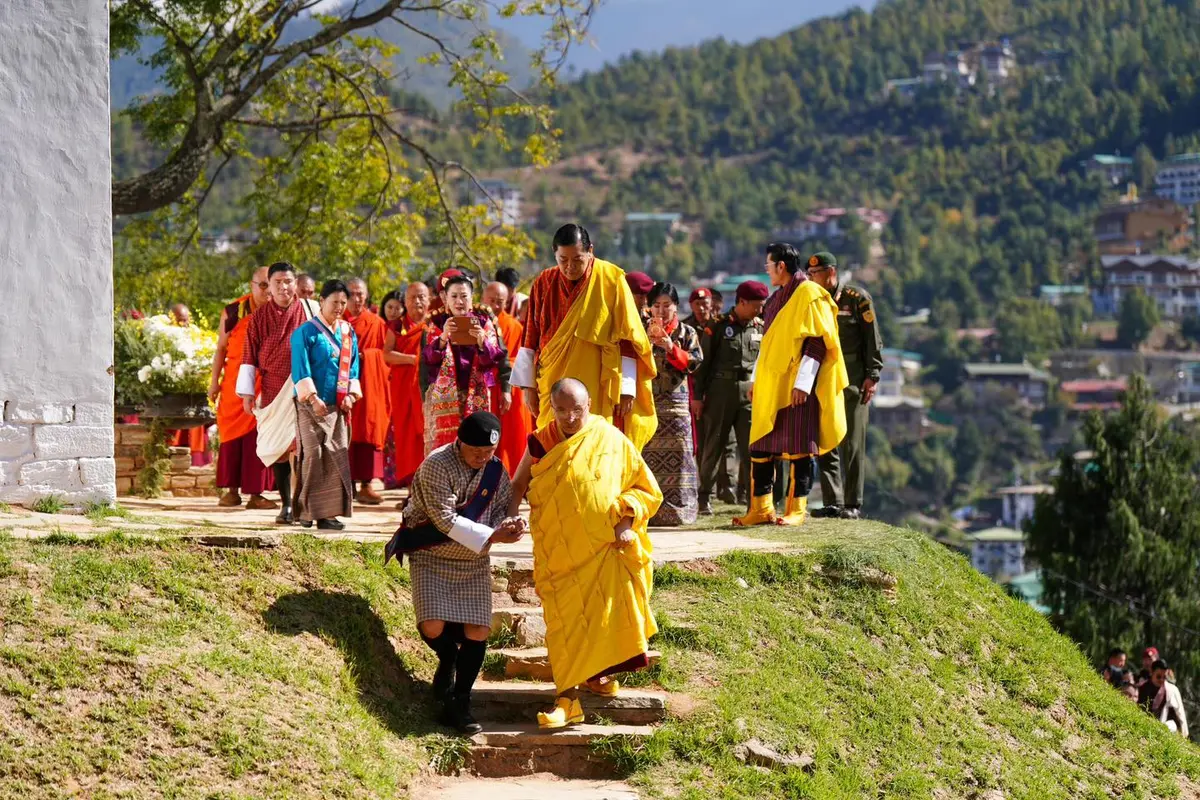
10. The current King is the fifth Druk Gyalpo — the fifth "Dragon King." His Majesty Jigme Khesar Namgyel Wangchuck took the throne in 2006 at age 26 and was crowned in 2008, making him one of the youngest heads of state in the world at the time.
11. He is called "the People's King" — and earns the name on foot. The King is famous for trekking days into remote valleys to meet villagers, sleeping in farmhouses along the way, and appearing unannounced at schools and hospitals across the kingdom.
12. The King and Queen's love story began when she was a child. By the account both have told publicly, they met at a family picnic when Jetsun Pema was seven and the young prince seventeen — and he half-jokingly promised that if neither were married when they grew up, he would marry her. He kept the promise.
13. Their 2011 wedding was held in Punakha Dzong — with no foreign celebrities. The King married Jetsun Pema on 13 October 2011 in the 17th-century fortress at the river confluence, in a purely Buddhist ceremony attended by ordinary Bhutanese rather than a global guest list.
14. They have three children. Crown Prince Jigme Namgyel Wangchuck (born 2016), Prince Jigme Ugyen Wangchuck (born 2020), and Princess Sonam Yangden Wangchuck (born 2023) — the sixth generation of the Wangchuck dynasty.
15. The Fourth King abdicated voluntarily at just 51. Jigme Singye Wangchuck — the monarch who coined Gross National Happiness — handed the throne to his son in 2006 while at the height of his popularity, precisely, he said, so the transition would happen while he could still guide it.
16. The Fourth King is married to four queens — who are all sisters. He wed the four sisters privately in 1979 and in a public ceremony in 1988; the eldest Queen Mother built the 108 chortens at Dochula.
17. Bhutan's constitution forces every king to retire. By law, the Druk Gyalpo must abdicate at 65 — Bhutan is one of the only monarchies on earth with a mandatory royal retirement age written into its constitution.
18. The crown itself is called the Raven Crown. Topped by the head of a raven — the form of Mahakala, Bhutan's guardian deity — it has crowned every Wangchuck king since 1907.
The Flag and the National Symbols
19. The flag is split between the palace and the monastery. The yellow half stands for the secular authority of the King; the orange half for the Buddhist spiritual tradition. Bhutan's identity, in two triangles.
20. The white dragon on the flag is Druk itself — clutching jewels. The thunder dragon's white colour stands for purity, and the jewels gripped in its claws for the country's wealth and the security of its people.
21. The national animal was created, says legend, by a saint as a party trick. Challenged to perform a miracle, the "Divine Madman" Drukpa Kunley snapped together the bones of a cow and the head of a goat — and the takin, an animal so odd that science gives it a genus all its own, walked away.
22. The national bird is the raven. It echoes the Raven Crown and Mahakala; harming one has long been considered a serious wrong.
23. The national flower grows above 3,000 metres and looks unreal. The Himalayan blue poppy (Meconopsis) — a papery, sky-blue bloom — was once thought to be a myth invented by travellers.
24. The national tree is the cypress, which Bhutanese associate with resilience — it roots itself in the most unforgiving ground, as monasteries do on cliffs.
25. The national sport is archery — declared when Bhutan joined the UN in 1971. Every village has a range, every festival has a match, and every match has heckling (see fact 77).
26. The national anthem is "Druk Tsendhen" — "The Thunder Dragon Kingdom." Adopted in the 1950s–60s era of nation-building, it invokes the dragon, the teachings, and the King in a single verse.
27. The national dress is worn daily, not for festivals. Men wear the knee-length wrapped gho, women the ankle-length kira — required in schools, government offices, and dzongs, and worn by choice most everywhere else. Bhutan's living dress code is centuries old.
Gross National Happiness and How Bhutan Is Run
28. "Gross National Happiness is more important than Gross Domestic Product." The Fourth King said it in the 1970s, half in answer to a journalist — and then built a governing philosophy around it that the world now studies. We've explained the whole system here — or measure your own GNH across the official nine domains.
29. GNH is not a slogan — it's measured. Four pillars, nine domains (from psychological wellbeing to time use to community vitality), surveyed nationally, with results that shape policy.
30. Every major policy is screened for happiness impact. Proposed laws and projects pass through a GNH policy screening tool before approval — the bureaucratic teeth behind the philosophy.
31. Bhutan is the world's first carbon-negative country. Its forests absorb several times the carbon its economy emits — not carbon-neutral, carbon-negative — a status it has held for years while richer countries chase 2050 pledges.
32. The constitution guarantees that forests can never fall below 60% of the country. Written into Article 5 in 2008. Current cover is around 70% — the constitution is a floor Bhutan floats well above.
33. Healthcare and education are free for every citizen — constitutionally. From primary school through university scholarships, and from village clinics to referrals abroad, paid for in significant part by tourism's Sustainable Development Fee. Here's exactly where the SDF goes.
34. Plastic bags have been banned since 1999. Bhutan moved against single-use plastic a full two decades before most of the world.
35. Bhutan was the first country on earth to ban tobacco sales outright. The ban (2004, tightened by law in 2010) made it the world's only tobacco-sales-free nation for years; the rules were relaxed in 2021, largely to kill cross-border smuggling during the pandemic.
36. Protecting nature is every citizen's constitutional duty. Article 5 doesn't just bind the state — it names each Bhutanese a "trustee of the Kingdom's natural resources."
Geography That Breaks Records
37. Bhutan holds the highest unclimbed mountain in the world. Gangkhar Puensum — 7,570 metres — has never known a human summit, after a handful of failed attempts in the 1980s.
38. And it will stay unclimbed — mountaineering above 6,000 metres is banned. Bhutan prohibited climbing its high peaks out of respect for the deities believed to dwell on them. In the entire world, only Bhutan chose gods over summit fees.
39. The country rises seven vertical kilometres in about 150 horizontal ones. From subtropical lowlands near 100 metres on the Indian border to 7,570 metres at Gangkhar Puensum — jungle to glacier in a land the size of Switzerland. The full geography story is remarkable.
40. Thimphu is among the highest capital cities on earth, sitting at roughly 2,334 metres — higher than any peak in the British Isles.
41. Thimphu is also one of the only capitals with no traffic lights. One set was installed decades ago; residents found it impersonal, and it was removed within days. White-gloved police direct traffic from a decorated kiosk instead.
42. Bhutan has no railways. Not a single kilometre of track — every journey is by road, foot, or wing (a cross-border rail link with India remains a plan on paper).
43. The whole kingdom runs on one time zone 30 minutes off India's. Bhutan Time is UTC+6 — half an hour ahead of New Delhi, 15 minutes behind Kathmandu, because the Himalaya enjoys a good fractional time zone.
44. Around 70% of Bhutan is forest. Not plantation — largely old, connected, wild forest, which is how a country this small stays carbon negative (fact 31).
45. More than half the country is legally protected. National parks, wildlife sanctuaries, and — crucially — biological corridors that connect them, letting tigers and snow leopards move across the kingdom without leaving protected land.
Wildlife Worth the Airfare
46. Bhutan sits in one of the world's ten biodiversity hotspots — the Eastern Himalaya — with over 5,400 plant species, about 46 kinds of rhododendron, and new species still being described.
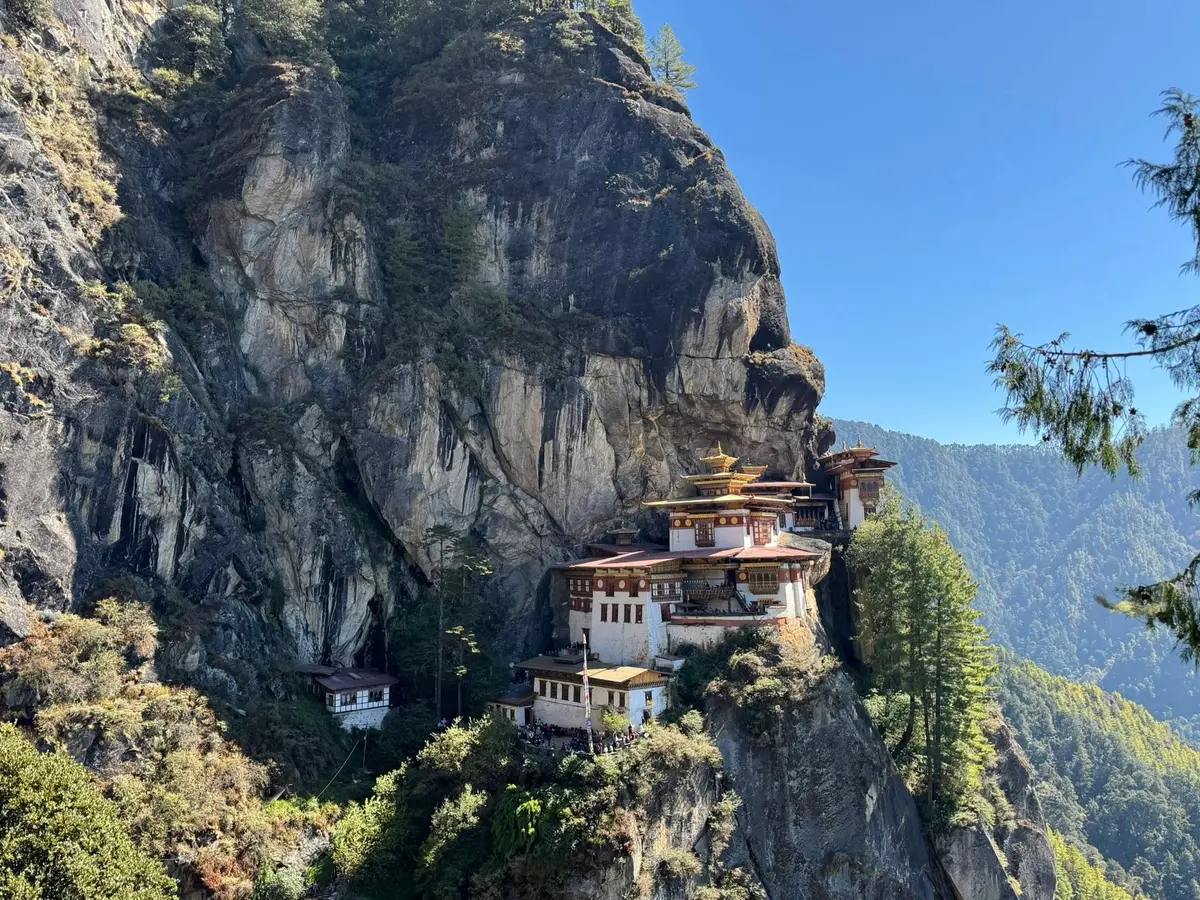
47. Science had to invent a category for the takin. Bhutan's national animal fits no existing group neatly; taxonomists placed the "gnu goat" in its own genus, Budorcas. See them at the Motithang preserve above Thimphu.
48. Bhutan's tigers climb mountains. Camera traps have recorded wild Bengal tigers above 4,000 metres — among the highest tiger evidence ever documented, made possible by those connected corridors (fact 45).
49. Roughly 130 snow leopards roam the high north, according to Bhutan's national survey — one of the healthiest densities anywhere in the cat's range.
50. The golden langur exists almost nowhere else on earth. This honey-coloured, black-faced monkey is confined to a sliver of Bhutan and adjacent Assam — and Bhutanese folklore long protected it as sacred.
51. Bhutan is a last refuge of the world's rarest heron. Fewer than 60 white-bellied herons are believed to survive globally; Bhutan's undammed rivers hold a significant share of them.
52. More than 770 bird species have been recorded in a country smaller than Switzerland — one of the highest densities of bird diversity on the planet.
53. The black-necked cranes circle the monastery when they arrive. Every winter in Phobjikha, locals say the cranes circle Gangtey Monastery three times on arrival and again on departure — and the valley celebrates them with a festival each 11 November.
54. A bear once walked into Thimphu with a tin can on its head — and walked out unharmed. The viral 2023 Taba rescue says everything about how Bhutan treats its wildlife. We told the full story here.
Religion and the Sacred
55. Bhutan is the world's last Vajrayana Buddhist kingdom. The tantric Buddhism that once spanned the Himalaya survives as a state religion only here.
56. The Tiger's Nest is named for an actual flight. Guru Rinpoche — the master who brought Buddhism to Bhutan in the 8th century — is said to have flown to the Paro cliffside on the back of a tigress and meditated in the cave the monastery now enshrines. The hike up is Bhutan's essential day.
57. Two of Bhutan's temples were built in 659 AD — as part of a set of 108. Kyichu Lhakhang in Paro and Jambay Lhakhang in Bumthang are counted among the 108 temples the Tibetan king Songtsen Gampo raised in a single legendary campaign to pin down a demoness who lay across the Himalaya.
58. The entire central monastic body migrates twice a year. Led by the Je Khenpo — Bhutan's chief abbot, a figure of equal precedence to the King — hundreds of monks move from Thimphu each winter to the warmth of Punakha Dzong, and back each summer. They have done this since the 17th century.
59. The death of Bhutan's founder was kept secret for over half a century. When the Zhabdrung Ngawang Namgyal — the lama who unified Bhutan in the 1600s — died, his ministers announced he had entered a long retreat. The state functioned in his name for roughly 54 years.
60. The phalluses painted on houses are serious religion. They honour Drukpa Kunley, the 15th-century "Divine Madman" whose shock-teaching methods included exactly what you think; his temple at Chimi Lhakhang remains Bhutan's great fertility pilgrimage.
61. Prayer flags come in exactly five colours for a reason. Blue, white, red, green, yellow — sky, air, fire, water, earth. The wind carries the printed prayers; a flag left to fade is a prayer completed, not neglected.
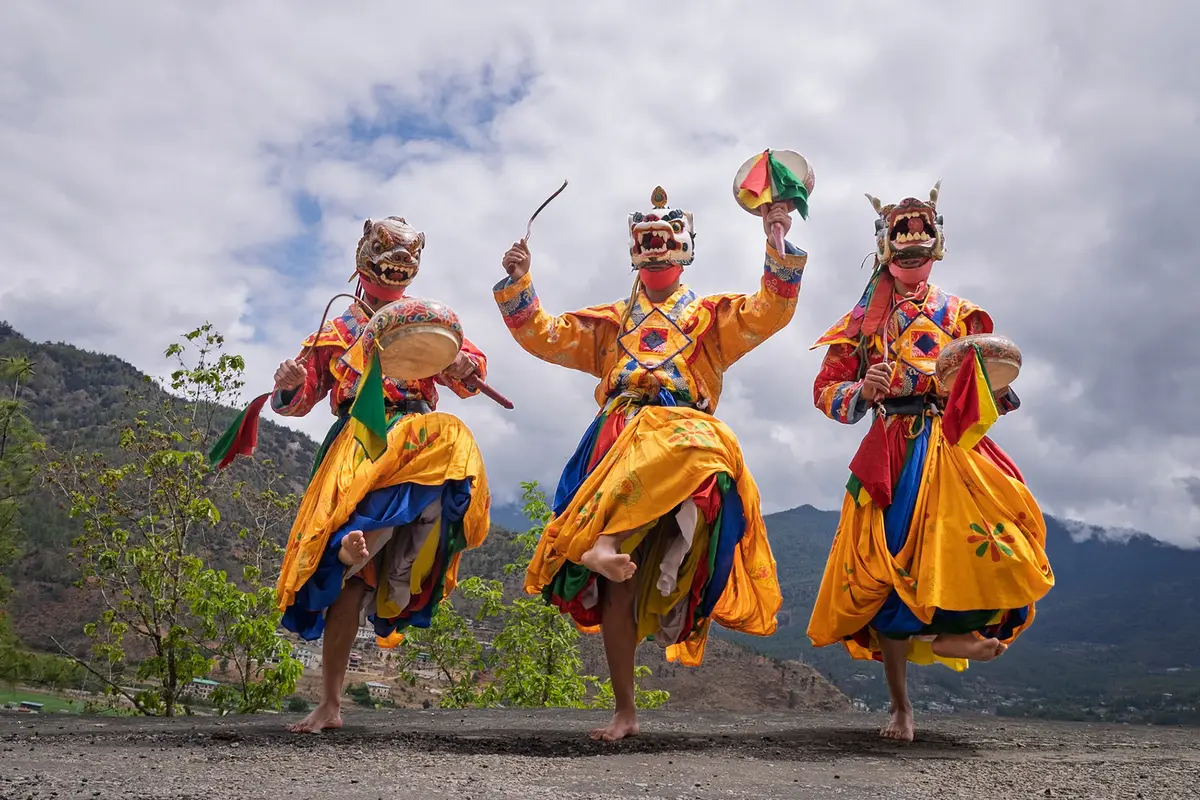
62. Festival crowds race the sunrise. At the great tshechus, a building-sized silk thongdrel is unfurled before dawn and rolled away before direct sunlight can touch it — seeing one is said to cleanse a lifetime's sins. Time your trip to a festival.
63. This list has 108 facts because Bhutan counts in 108s. 108 beads on the mala, 108 defilements to overcome, 108 temples in Songtsen Gampo's vow, 108 butter lamps lit for the departed. In Bhutan the number is a habit of devotion.
Dzongs and Landmarks
64. Bhutan's greatest fortresses were built without a single nail. The dzongs — and traditional houses besides — stand on joinery alone: precision-cut timber locked together, flexible enough to ride out earthquakes. Here's how the nail-free system works.
65. Punakha Dzong is officially "the Palace of Great Happiness." Built in 1637–38 at the meeting of two rivers, Pungthang Dewachen Phodrang is where kings are crowned, where the royal wedding was held (fact 13), and where the monastic body winters (fact 58).
66. Punakha was the capital of Bhutan until 1955. Thimphu is a young capital; for over 300 years the seat of power sat at the river confluence.
67. The Tiger's Nest you visit rose from ashes. A 1998 fire gutted much of the monastery; Bhutan rebuilt it by hand, using traditional methods, reconsecrating it within years.
68. The giant Buddha above Thimphu contains 125,000 smaller Buddhas. The 51.5-metre bronze Buddha Dordenma — among the largest seated Buddhas on earth — is filled with one hundred twenty-five thousand miniature statues, each individually consecrated.
69. Bhutan has zero UNESCO World Heritage Sites — by choice of pace, not poverty of heritage. Its dzongs and sacred sites sit on the tentative list while the kingdom weighs what inscription would mean. Meanwhile 198 registered heritage sites are protected under Bhutanese law.
70. There is a lake where a saint dove in with a burning lamp — and came out with treasure, lamp still lit. Membartsho, the "Burning Lake" of Bumthang, is where Pema Lingpa recovered sacred relics in the 15th century; it remains one of Bhutan's holiest waters.
71. A 403-kilometre walking trail across the whole country reopened in 2022 — after 60 years. The Trans Bhutan Trail, the old mule-and-messenger route linking east to west, was restored end to end and opened to trekkers for the first time since the 1960s.
72. Only a few dozen pilots on earth are certified to land at Paro. The approach threads between 5,000-metre ridges with no radar guidance — by hand, by sight, every single landing. Everything about flying into Bhutan.
Culture and Daily Life
73. Most Bhutanese have no surname. Children receive two given names — often from a lama rather than their parents — and nothing marks family lineage except in the royal and noble houses. Names are largely unisex, too.
74. Etiquette is codified — and taught. Driglam namzha, the formal code of dress and conduct (how to wear the gho, how to greet, how to sit in a dzong), was reinforced by royal decree in 1989 and is still taught in schools.
75. Astrologers set the nation's calendar. From weddings to funerals to the dates of state events, auspicious timing is calculated by trained astrologers — many at Pangri Zampa monastery, the royal astrology college near Thimphu.
76. Bhutanese archers shoot at more than double the Olympic distance. Traditional matches place the target 145 metres away — Olympic archery is 70 — and hitting a target the size of a breadboard at that range is considered a normal weekend.
77. Distraction is a legal tactic in archery. Opposing teams sing, dance, and hurl elaborate insults at the shooter mid-draw; teammates dance a victory step for every hit. It is the loudest quiet sport on earth.
78. The other national obsession is khuru — lawn darts, played fearlessly. Palm-sized darts hurled 20-plus metres at a paddle-sized target, traditionally between villages, with the same singing and heckling.
79. Thirteen crafts are protected as national arts. The zorig chusum — weaving, thangka painting, wood carving, blacksmithing, papermaking, and eight more — have their own national institutes where students train for years.
80. Bhutan still makes paper the 8th-century way. Desho paper, pounded from daphne bark, is insect-resistant and nearly tear-proof — monasteries trusted their scriptures to it for a millennium.
81. The national social lubricant is a betel leaf parcel called doma. Areca nut, lime paste, betel leaf — offered at every meeting and celebration, the red-stained smile is Bhutan's handshake.
Food and Drink
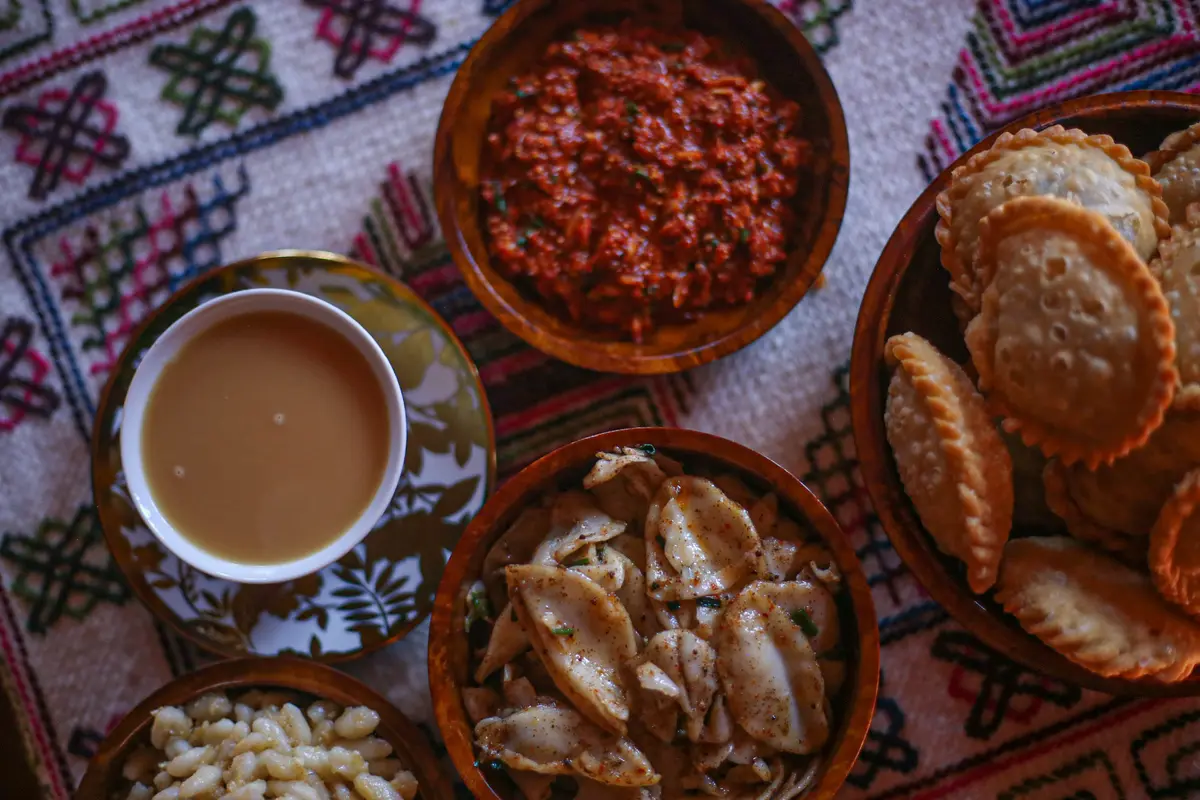
82. In Bhutan, chillies are a vegetable, not a spice. They are eaten by the plateful, dried on every rooftop each autumn, and consumed at breakfast without comment.
83. The national dish is chillies drowned in cheese. Ema datshi — hot chillies stewed in melted local cheese — appears at virtually every meal in the kingdom. Our full guide to Bhutanese cuisine explains the addiction.
84. Bhutan's red rice grows at 2,500 metres on glacier water. Nutty, russet, and mineral-rich, it's one of the very few rices on earth that thrives at such altitude.
85. Tea here is buttered and salted, not sweetened. Suja — churned with butter and salt — is calorie fuel for a Himalayan climate, drunk by the thermos.
86. The home spirit is ara, distilled from rice or grain, often warmed with butter and egg, and legally a home craft more than an industry.
87. Bhutanese cheese includes a variety you cannot bite. Chugo — yak cheese dried rock-hard and threaded on strings — is sucked and softened for an hour or more per piece. It's the Himalayan energy bar.
88. There is no McDonald's, Starbucks, KFC, or Burger King anywhere in Bhutan. Not one international fast-food chain operates in the kingdom — perhaps the only country its size that can say so.
89. A Swiss immigrant gave Bumthang cheese and beer. Fritz Maurer arrived in the 1960s and introduced Emmental-style cheese and later brewing to the valley — today's Bumthang cheese and Red Panda weissbier are his legacy.
90. Momos are the universal second language. The Tibetan-style dumplings — beef, pork, cheese, or ezay-fired vegetable — are Bhutan's street food, café staple, and midnight craving in one.
Modern Bhutan: The Surprises
91. Television and the internet arrived in 1999 — last country in the world. By royal decision, Bhutan skipped straight from no broadcast media to the digital age within a single generation.
92. The first motor road was completed in 1962. Within living memory, every journey in Bhutan — royal, monastic, or mercantile — was made on foot or by mule.
93. Bhutan's currency is pegged 1:1 to the Indian rupee. The ngultrum, introduced in 1974, tracks the rupee exactly, and Indian notes circulate freely alongside it.
94. Bhutan once issued postage stamps that were tiny vinyl records. The kingdom's famously inventive postal service released playable "talking stamps" in 1973 — decades later it pioneered personalised stamps with your own photo, printable while you wait at the Thimphu GPO.
95. Bhutan vaccinated almost its entire adult population against COVID-19 in about two weeks. The 2021 drive — coordinated with astrologically auspicious timing and volunteer desuup corps — reached over 90% of eligible adults in days, one of the fastest national campaigns ever recorded.
96. A Bhutanese film about a yak in a classroom reached the Oscars. Lunana: A Yak in the Classroom, shot off-grid in the world's most remote school settlement, earned Bhutan's first Academy Award nomination (Best International Feature, 2022).
97. Bhutan's biggest export is falling water. Hydropower sold to India dominates national revenue — Bhutanese rivers light millions of Indian homes, which is also how a poor country affords free healthcare (fact 33).
98. The kingdom's digital signature is .bt and +975. Two of the internet and telephone age's least-dialled codes — by design, not accident.
99. Bhutan has competed in the Olympics since 1984 and never won a medal — yet. Its athletes traditionally compete in archery and shooting; the kingdom treats participation itself, in gho and kira at the opening ceremony, as the point.
Travel: The Kingdom and Its Guests
100. Tourism began in 1974 — with 287 visitors. The first tourists were admitted the year of the Fourth King's coronation. Half a century later, Bhutan still measures tourism in tens of thousands, not millions.
101. Bhutan charges a Sustainable Development Fee — and spends it on citizens. The $100-per-night SDF funds the free healthcare and education in facts 33 — making every traveller a small stakeholder in the kingdom's wellbeing. How the fee and visa actually work.
102. The national airline made its first flight in 1983. Drukair began with a single small plane hopping to Kolkata; today it and Bhutan Airlines connect Paro — still the kingdom's only international airport — to a handful of Asian hubs.
103. Whole regions opened to travellers only recently. The Haa Valley admitted its first tourists in 2002; the semi-nomadic far-eastern valleys of Merak and Sakteng waited until 2010.
104. The world's highest-altitude festival crowns Bhutan's highland calendar. The Royal Highland Festival at Laya — a village at roughly 3,800 metres, reachable only on foot — celebrates yaks, mastiffs, and the herding life each October.
105. The black-necked crane has its own festival on 11 November in Phobjikha's monastery courtyard — a date shared, fittingly, with the birthday of the Fourth King.
106. The monsoon is Bhutan's best-kept travel secret. June to August brings discounts, empty trails, and impossibly green valleys — the counterintuitive case is here.
107. Bhutan is now building a "Mindfulness City" the size of Singapore. Gelephu Mindfulness City, announced by the King in 2023 on the southern plains, is the kingdom's boldest project since democracy itself. We've mapped what it means.
108. And the 108 chortens are real — you can count them. On the Dochula Pass, an hour east of Thimphu at 3,100 metres, stand the 108 Druk Wangyal chortens built by the eldest Queen Mother, with the high Himalaya ranged behind them on a clear morning. Fact number 108 is best verified in person.
Frequently Asked Questions
What is Bhutan most famous for?
Gross National Happiness, the Tiger's Nest monastery, being the world's first carbon-negative country, its "high value, low volume" tourism policy, and its status as the last Vajrayana Buddhist kingdom — facts 28, 56, 31, 101, and 55 above.
Why is Bhutan called the Land of the Thunder Dragon?
From "Druk Yul," the kingdom's own name for itself — rooted in the Drukpa Buddhist school, founded after thunder (the dragon's voice) was heard over the site of its first monastery. The dragon appears on the flag, the anthem, and the King's own title, Druk Gyalpo.
Is Bhutan expensive to visit?
It's deliberately mid-to-premium: the $100-per-night SDF plus tour costs put a week's trip in the $2,500–4,000+ range per person, all-inclusive. Full numbers in our Bhutan vacation cost guide — and what the fee buys is in facts 31–33.
Why is the number 108 sacred in Bhutan?
In Buddhist tradition 108 is the number of worldly defilements to overcome — hence 108 mala beads, 108 butter lamps, Songtsen Gampo's 108 temples, and the 108 chortens of Dochula. A list of Bhutan facts could hardly be any other length.
Made you want to fact-check number 108 in person? Talk to our team or start with the visa guide and best time to visit — the dragon kingdom holds up better in person than on paper.