How a Kingdom of 800,000 Talks to the World: Bhutan and the Quiet Art of Buddhist Diplomacy
By Best of Bhutan Research Desk · August 5, 2026 · 18 min read
There is a particular kind of question visitors ask their guides somewhere around day four in Bhutan, usually on a mountain road between two valleys. It goes something like: how does a country this small, wedged between the two most populous nations on earth, stay so completely itself?
It is a better question than most travellers realise, and it now has a serious scholarly answer. Writing in The Diplomat on 5 August 2026, Jack Meng-Tat Chia — Foo Hai Associate Professor in Buddhist Studies at the National University of Singapore, founding chair of its Buddhist Studies Group, and editor of Figures of Buddhist Diplomacy in Modern Asia (Bloomsbury, 2026) — makes the case that the most interesting Buddhist diplomacy in Asia is not being practised by its largest powers at all.
His argument runs roughly like this. As strategic competition between China and India intensifies, Buddhism has become an increasingly visible instrument of foreign policy: China positioning itself as a centre of Mahayana civilisation, sponsoring forums, restoring sacred sites, weaving Buddhist heritage into the Belt and Road Initiative; India, as the religion's birthplace, expanding pilgrimage circuits and lending sacred relics abroad. But that focus, Chia writes, "obscures a quieter, yet equally significant, story" — one told by two of Asia's smallest states, Bhutan and Singapore, whose limited geopolitical weight has pushed them to cultivate influence through cultural networks rather than hard power.
We think the argument is correct, and we think it explains something no itinerary description ever quite captures: why being a guest in Bhutan feels different from being a tourist somewhere else. The values that shape how this country talks to other governments are the same values that shape how it receives visitors. Understanding the first illuminates the second.
What "Buddhist Diplomacy" Actually Means
The phrase can sound like a euphemism, so it is worth being precise.
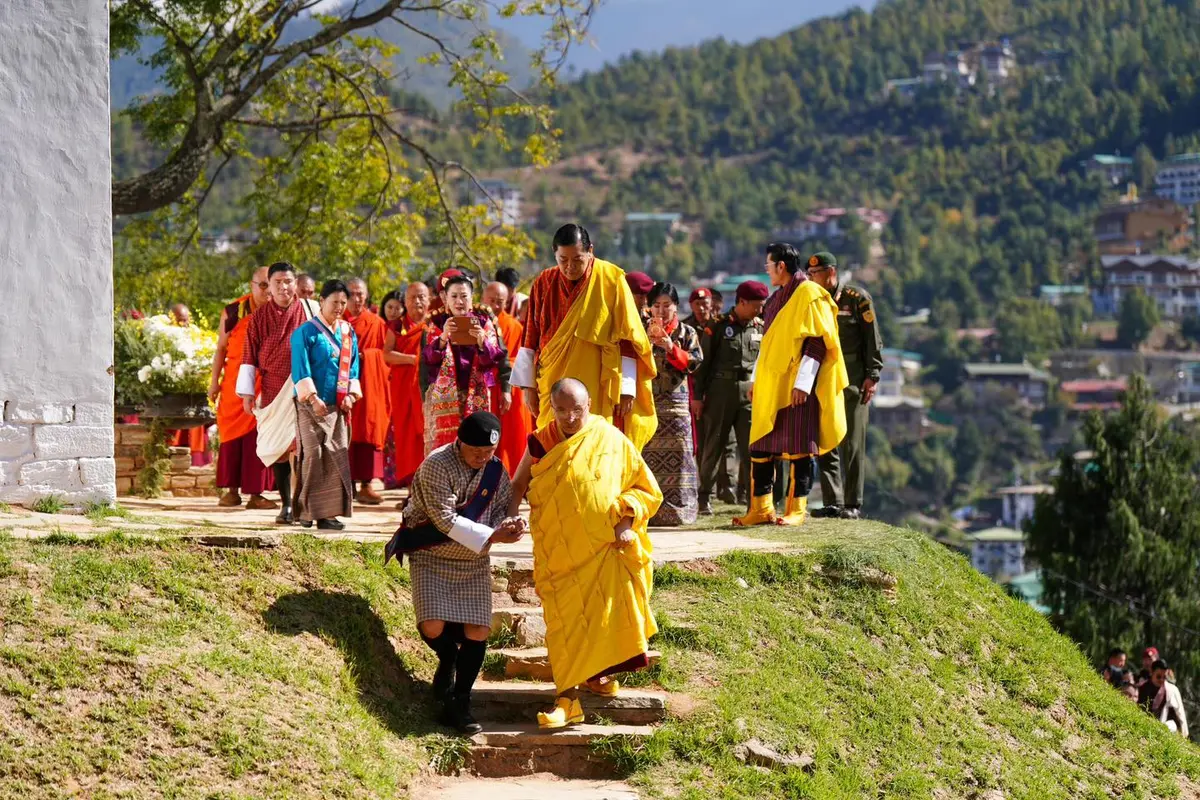
Buddhist diplomacy refers to the use of Buddhist heritage, institutions, symbolism, and ethical vocabulary as instruments of foreign policy. In practice it takes several forms: relic exchanges and pilgrimage circuits; monastic and scholarly networks that cross borders more easily than diplomats do; the restoration and sponsorship of sacred sites; international forums organised around Buddhist themes; museum exhibitions of Buddhist material culture; and — most subtly — the framing of national policy in ethical language that carries moral authority beyond a country's material weight.
For large powers, this is one lever among many. For a small state, the calculation is different. Bhutan cannot compete on the scale of relic diplomacy or infrastructure spending. What it possesses instead is harder to manufacture: an unbroken living tradition, and a national practice that visibly matches its stated principles. That is the currency, and Bhutan spends it carefully.
Bhutan's Deliberate Smallness
Start with the fact that most surprises people: Bhutan maintains formal diplomatic relations with fewer than sixty countries — and with none of the five permanent members of the UN Security Council. No embassy exchange with the United States, the United Kingdom, France, Russia, or China.
This is not an oversight or a symptom of obscurity. It is policy, sustained across decades, reflecting a clear-eyed reading of what happens to small countries that accumulate powerful friends faster than they can manage them. Bhutan prefers multilateral venues — the UN, SAARC — where a small state speaks with a seat rather than a supplicant's posture, and it invests deeply in a smaller number of bilateral relationships it can genuinely sustain.
India remains the anchor: security partner, largest trading partner, funder of much of Bhutan's hydropower development. The relationship with China — where, as Chia notes, Bhutan still has no formal diplomatic relations — has been managed through decades of patient boundary talks, the current King navigating a position between two giants that would have swallowed a less careful state long ago.
The lesson embedded here is one larger countries rarely learn: influence is not the same as presence. A country can be in fewer rooms and still be heard, provided what it says in them is distinctive enough to be worth repeating.
Gross National Happiness as a Sovereignty Strategy
Here Chia offers a reading of Gross National Happiness that we think is the sharpest available, and it is worth quoting the shape of it.
GNH is usually presented abroad as a gentle alternative to GDP — a charming Himalayan preference for wellbeing over output. Chia argues it was always more strategic than that. The Fourth King, Jigme Singye Wangchuck, developed GNH "not simply as an alternative measure of development, but as a strategy for reconciling modernization with the preservation of Bhutan's Buddhist culture and national identity." For a small state situated between India and China, that fusion served a hard-headed purpose: turning cultural distinctiveness into a means of safeguarding sovereignty, while giving Bhutan an international profile far beyond its size.
That reframing matters. It means GNH was never merely an ethical preference; it was an answer to the question every small country faces — how do we modernise without dissolving? Bhutan's answer was to make its distinctiveness the point, and then to make that distinctiveness legible to the outside world.
The Word Bhutan Gave the World
The clearest demonstration is a piece of vocabulary now embedded in global institutions.
In July 2011, Bhutan sponsored — with 68 co-sponsors — UN General Assembly resolution 65/309, "Happiness: Towards a Holistic Approach to Development," which stated plainly that GDP does not adequately capture human wellbeing. The following June, the General Assembly unanimously adopted resolution 66/281, proclaiming 20 March as the International Day of Happiness.
Sit with the scale of that. A country of roughly 800,000 people persuaded the entire membership of the United Nations to adopt a date on the global calendar built around a concept it had originated in 1972. Wellbeing indices now sit inside OECD frameworks, national statistics offices, and central-bank speeches. The World Happiness Report is annual news in countries that could not locate Thimphu on a map.
That is Buddhist diplomacy functioning exactly as the theory describes: an ethical idea, rooted in a Buddhist understanding of what a good life consists of, translated into the procedural language of international institutions — and adopted.
Bangkok and Thimphu: Two Monarchies, One Language
If the UN campaign shows Buddhist diplomacy working multilaterally, Bhutan's relationship with Thailand — Southeast Asia's leading Theravāda Buddhist monarchy — shows it working bilaterally. Chia highlights not a single event but a sequence, and the sequence is the argument:
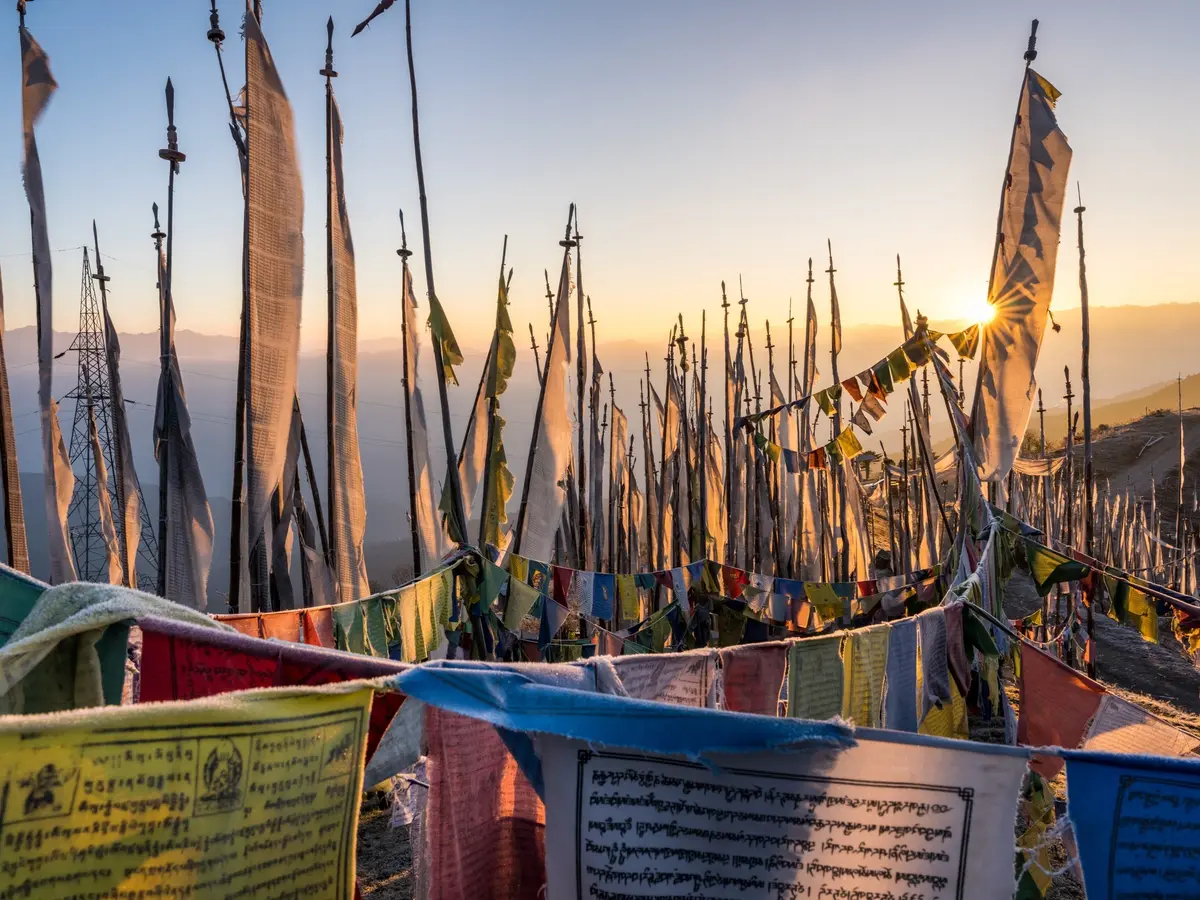
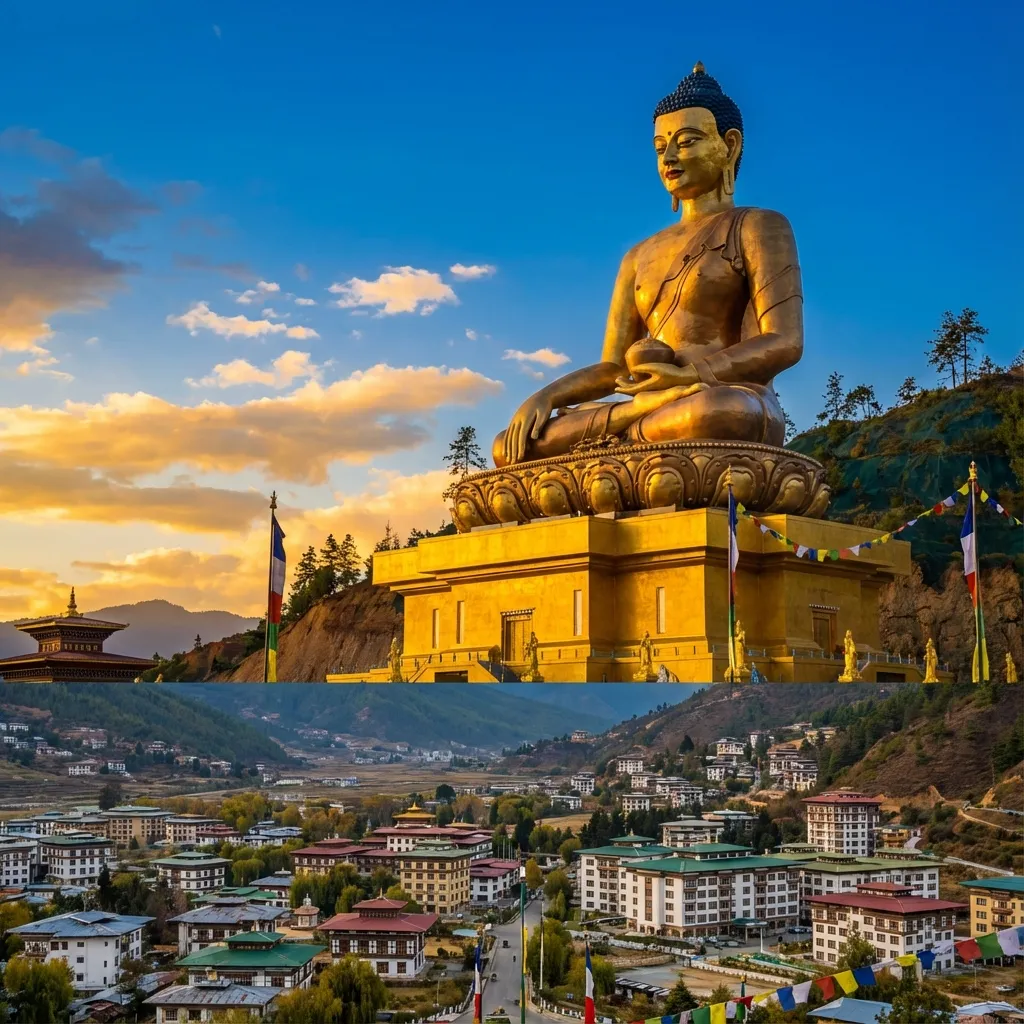
- April 2025 — King Maha Vajiralongkorn and Queen Suthida make a state visit to Bhutan. It is the first visit by a reigning Thai monarch, and the first state visit abroad of King Vajiralongkorn's reign. On 26 April, Their Majesties join King Jigme Khesar Namgyel Wangchuck and Queen Jetsun Pema at a Buddhist chanting ceremony at the Buddha Dordenma statue above Thimphu.
- December 2025 — King Jigme Khesar Namgyel Wangchuck receives an honorary doctorate from Chulalongkorn University, Thailand's most prestigious institution.
- June 2026 — the King of Bhutan attends the funeral rites of Princess Bajrakitiyabha, an act of presence at a moment of national mourning that no protocol requires and every observer notices.
Diplomatic ties date to 1989; the King of Thailand first visited Bhutan in 1991 as Crown Prince; the two countries have since concluded a Free Trade Agreement. But what makes this Buddhist diplomacy rather than ordinary bilateralism is the shared frame. Thailand is Theravāda, Bhutan is Vajrayāna, and the doctrinal distance between them is real. Both, however, are Buddhist monarchies in which the crown holds a recognised relationship to the sangha. As Chia puts it, Buddhism serves "as a shared cultural and symbolic language through which the two Buddhist monarchies deepen their bilateral relations."
Chanting together at Buddha Dordenma is not decoration around the real diplomacy. It is the diplomacy — conducted in a register both courts read fluently and neither has to translate.
For Bhutan there is also a strategic dividend: a substantial partnership outside its immediate neighbourhood. In a geography defined by two enormous neighbours, a close friend in Southeast Asia is not merely pleasant. It is breathing room.
If you visit Thimphu, you will almost certainly stand at Buddha Dordenma yourself — it appears on nearly every itinerary we run, including the Classic Cultural Tour. It is worth knowing that the 169-foot bronze you are photographing is also, periodically, a diplomatic venue.
Gelephu: The Philosophy Meets Capital — and the Case for the Defence
The newest expression of this approach is Gelephu Mindfulness City, and Chia treats it with a candour we want to preserve rather than smooth over.
Announced by His Majesty King Jigme Khesar Namgyel Wangchuck on National Day, 17 December 2023, and established by Royal Charter in December 2024, the project designates a Special Administrative Region of more than 2,600 square kilometres — around 5% of Bhutan's territory — on the southern plains bordering Assam. Master planning is led by Bjarke Ingels Group. The development horizon reported in international coverage runs to $100 billion.
Its purpose is to extend Buddhist diplomacy into the economic realm, "transforming mindfulness, sustainability, and well-being from ethical principles into a distinctive national brand for attracting global investment and talent." The SAR operates under more flexible commercial regulation than the rest of the country, but screens investors and businesses for respect for Bhutanese culture and commitment to sustainable, equitable development. Bhutan is, in effect, saying: we will open a door, and we will decide what walks through it.
Then Chia names the tension directly, and he is right to raise it: "Buddhist values that caution against excessive materialism are being strategically mobilized to facilitate the country's deeper integration into global capitalism."
It is the objection every thoughtful observer arrives at, and it deserves a real answer rather than a defensive one. Here is ours, in six parts — because setting them out is also the clearest short explanation of what Bhutan is actually doing.
1. The first pillar of Gross National Happiness is economic development
The objection assumes GNH is an anti-economic philosophy, so that building an economic hub in its name must be a contradiction. But that is not what the doctrine says. GNH rests on four pillars, and the first is sustainable and equitable socio-economic development. The others are environmental conservation, preservation and promotion of culture, and good governance.
Read in that light, Gelephu is not GNH being compromised by economics. It is the pillar that has always been there finally receiving the same institutional seriousness the other three have enjoyed for fifty years. Bhutan protected its forests with a constitutional mandate, its culture with a national dress code and living monastic institutions, its governance with a voluntarily granted democracy. Pillar one has never had an instrument of comparable ambition. Now it does.
2. Buddhism cautions against attachment, not against prosperity
The doctrinal premise deserves examination too. Buddhism has never required poverty. The Buddha's decisive insight, after years of extreme austerity, was that self-mortification is as much a dead end as indulgence — the Middle Way is a rejection of both extremes, and asceticism is explicitly one of them.
Right livelihood is a limb of the Noble Eightfold Path: not an instruction to avoid commerce, but to conduct it without harm. The tradition's most celebrated lay patron, Anāthapiṇḍika, was a wealthy banker whose fortune built the Jetavana monastery. Across Asia, Buddhist monasteries functioned for centuries as substantial economic institutions — landholders, lenders, and patrons of the arts.
Note Chia's own careful wording: Buddhist values caution against excessive materialism. "Excessive" is a word that presumes a permissible range. The question a Buddhist framework asks of Gelephu is not whether wealth, but how acquired and to what end — which is precisely the question the SAR's investor screening is designed to ask.
3. The alternative to engagement is not purity — it is depopulation
This is the part of the debate that abstractions obscure, so here are the numbers.
The stock of Bhutanese migrants in Australia more than doubled between 2020 and 2024, from roughly 12,400 to over 25,300. More than half of those leaving hold university degrees, against about 7% of Bhutan's working-age population — this is not ordinary migration but the concentrated departure of the educated. Nearly half came from the civil service, and in 2024 teachers and health workers accounted for close to 70% of voluntary public-sector resignations. By March 2025 the Ministry of Education was recalling retired teachers to fill 1,126 vacancies, and the health system was short 172 doctors and specialists and 824 nurses.
Consider what those figures actually describe. A monastery without monks is a museum. A valley whose young people have all gone to Perth is scenery. Culture is not a artifact that survives in the absence of people; it is a practice that requires practitioners, and practitioners require livelihoods.
The purity position, applied consistently, produces a beautifully preserved country with nobody left to inherit it. That is not cultural protection. It is a slower form of the same loss, and Bhutan has looked at the numbers and declined it.
4. Bhutan has run this experiment before — and won it
The strongest argument is not theoretical. It is that Bhutan has faced exactly this choice once already, and its answer has fifty years of evidence behind it.
In 1974, when the country opened to tourism, critics made precisely the objection now aimed at Gelephu: that admitting outsiders would commodify sacred culture and hollow it out. Bhutan's response was not to refuse. It was to invent "High Value, Low Volume" — capping numbers, pricing deliberately, requiring licensed guides, and directing revenue into healthcare, education, and conservation.
Five decades later, compare Bhutan's cultural integrity with that of Himalayan neighbours who chose volume. The dzongs are working institutions, not stage sets. The national dress is worn to the office, not for photographs. Sacred sites remain in active use rather than converted into ticketed attractions.
Gelephu is the same playbook applied to capital instead of tourists: screen who enters, set the terms, cap the exposure, keep authorship. Bhutan is not improvising a novel gamble. It is repeating a move it has already executed successfully at national scale.
5. Bhutan has repeatedly proven it will leave money on the table
Screening commitments are only as good as a country's willingness to enforce them against its own financial interest. Bhutan's record here is close to unique.
In 1994 it banned climbing above 6,000 metres, and in 2003 it prohibited mountaineering entirely — out of respect for communities who regard the peaks as living deities. The result is that Gangkhar Puensum, at 7,570 metres, remains the highest unclimbed mountain on earth, and will stay that way. Bhutan forwent an entire industry, permanently, on religious grounds.
It has capped tourist arrivals when more were available, and set a Sustainable Development Fee high enough that it demonstrably suppressed demand — then held the policy through the criticism.
A state that refuses summit permits on principle has earned more benefit of the doubt on investor screening than one that has never once chosen values over revenue.
6. Mindfulness is being monetised regardless — the question is whether the source has a say
The global wellness industry already sells mindfulness at enormous scale: apps, retreats, corporate programmes, most of it stripped of lineage, context, and any accountability to the traditions it draws from. That commercialisation is happening whether or not Bhutan participates.
Against that backdrop, a country with an unbroken Vajrayāna tradition asserting authorship over a concept it has actually practised for centuries reads less like appropriation and more like its correction. Bhutan is not introducing mindfulness to the market. It is arriving late to a market already trading in its inheritance, and proposing terms.
What would prove us wrong
Intellectual honesty requires naming what failure would look like, so here it is. We would consider the criticism vindicated if: the investor screening is quietly relaxed once serious capital arrives; the SAR's regulatory flexibility begins migrating into the rest of the country; environmental standards are traded for tenancy; or Gelephu's prosperity accrues to outside investors while Bhutanese remain in service roles.
Those are real risks and we do not dismiss them. But note that every one of them is a failure of implementation, not of the underlying idea — and Bhutan's institutional record on holding a line, from the mountaineering ban to the tourism cap, is the strongest available reason to think the line will hold.
The attempt itself — a country of 800,000 proposing that global capital should meet its conditions rather than the reverse — is not a betrayal of the philosophy. It is the philosophy under load, which is the only place a philosophy is ever really tested.
We have written separately about the geography and thinking behind Gelephu, which sits close to the historic southern gateway explored in our piece on Sarbang and Guru Rinpoche's entry into Bhutan — a reminder that this "new" corridor has been a threshold for a very long time.
The Singapore Counterpoint: Why There Is No Single Model
Chia's essay is a comparison, and the second half is what gives the argument its force. Singapore, he shows, practises Buddhist diplomacy too — under conditions almost opposite to Bhutan's.
Singapore is a secular, multireligious republic with no official religion. It cannot ground diplomacy in Buddhist kingship or religious identity. So it has done something else: positioned itself as an intermediary, using Buddhist heritage to facilitate dialogue among governments, religious communities, scholars, and cultural institutions — rather than competing with larger powers, making itself useful as a connector between them.
Chia's examples are vivid. The late Venerable Hong Choon, whose ties with Thailand earned him the title of Supreme Chinese Monk from King Bhumibol Adulyadej, and who cultivated extensive networks in China throughout the 1980s — before Singapore and China established diplomatic relations in 1990. George Yeo, as foreign minister, championing the revival of Nalanda University as part of an "Asian Renaissance" recovering the region's shared civilisational heritage — and doing so as a Catholic deeply engaged with Asian philosophies, demonstrating that Buddhism can transcend religious affiliation to become a diplomatic resource. And Singapore's museums, including the Asian Civilizations Museum's forthcoming Dunhuang exhibition with the Dunhuang Academy in China, using Buddhist art as a medium of cultural diplomacy.
The contrast is the point. In Bhutan, Buddhism is embedded in monarchy, national identity, and statecraft. In Singapore, it functions as one cultural resource among several, available for building regional connections. Chia's conclusion: small-state Buddhist diplomacy has no single model, and its effectiveness lies precisely in its adaptability to different political and cultural contexts.
For Bhutan, the useful implication is that its version cannot be copied — and equally, that it should not try to copy anyone else's. What it has is not transferable, which is exactly what makes it valuable.
The Environmental Dimension
No account of Bhutanese soft power is complete without the forests.
Bhutan's constitution requires that at least 60% of the country remain under forest cover in perpetuity — not a target but a binding constraint on every future government. The country absorbs more carbon than it emits, making it one of very few carbon-negative nations on earth, and more than half its territory lies within protected areas and connecting biological corridors.
At climate negotiations this produces something rare: a delegation whose moral standing does not depend on promises about the future. Bhutan can point to what already exists.
It is worth naming the Buddhist root rather than treating this as coincidence. In a worldview where sentient life is continuous across species and rebirth, and where the consequences of action extend beyond a single lifetime, a constitutional forest requirement is not an environmental policy bolted onto a religious culture. It is the same proposition in legal language. Our reporting on the Asiatic black bear rescue and the first photographic record of the Himalayan musk deer in Tsirang shows what that looks like at ground level.
Why It Works: Practice Before Projection
Here is the crux, and the reason we find Chia's framing persuasive rather than merely flattering.
Soft power fails when the projection outruns the practice. Audiences are good at detecting the gap between what a country says about itself and what it does, and once detected, the messaging becomes actively counterproductive.
Bhutan's advantage is that the practice came first, by a long margin. The forests were protected before carbon markets existed. GNH was articulated in 1972, decades before wellbeing economics became fashionable, at a moment when it brought no international benefit whatsoever. Monastic institutions have shaped public life continuously since the 17th century, when the Zhabdrung Ngawang Namgyal established the dual system of spiritual and temporal authority the country still recognises. None of it was designed to impress anybody abroad.
That sequence is the whole asset. When Bhutan speaks about wellbeing at the UN, or screens investors at Gelephu, or chants alongside a Thai king at Buddha Dordenma, it is not performing an identity. It is extending one.
Small states cannot buy credibility. They can only accumulate it, slowly, by being consistent long enough that consistency becomes the reputation. Bhutan has been at it for a while.
What This Means If You Are Going to Visit
This is the part we care about most, because it changes what a trip here actually is.
The tourism policy is foreign policy. Bhutan's "High Value, Low Volume" approach and its Sustainable Development Fee are usually explained to travellers as cost items. They are better understood as the tourism expression of everything above: a small country setting the terms of its own engagement with the world rather than accepting the terms mass tourism would impose. The fee funds free healthcare, education, and conservation. You are not paying an entry toll; you are participating in a development model. Our full explanation of the SDF sets out the mechanics.
You are received as a guest, not processed as a customer. The licensed-guide requirement, which some visitors initially read as restriction, is the practical form of a country that would rather host you properly than let you wander. Most travellers realise within two days that they are having conversations, not transactions.
The sacred sites are not attractions. The dzongs you visit are working seats of both government administration and monastic community. The temples hold active practice. Admission is a courtesy extended by a living institution — which is why etiquette matters, and why a good guide spends time on it.
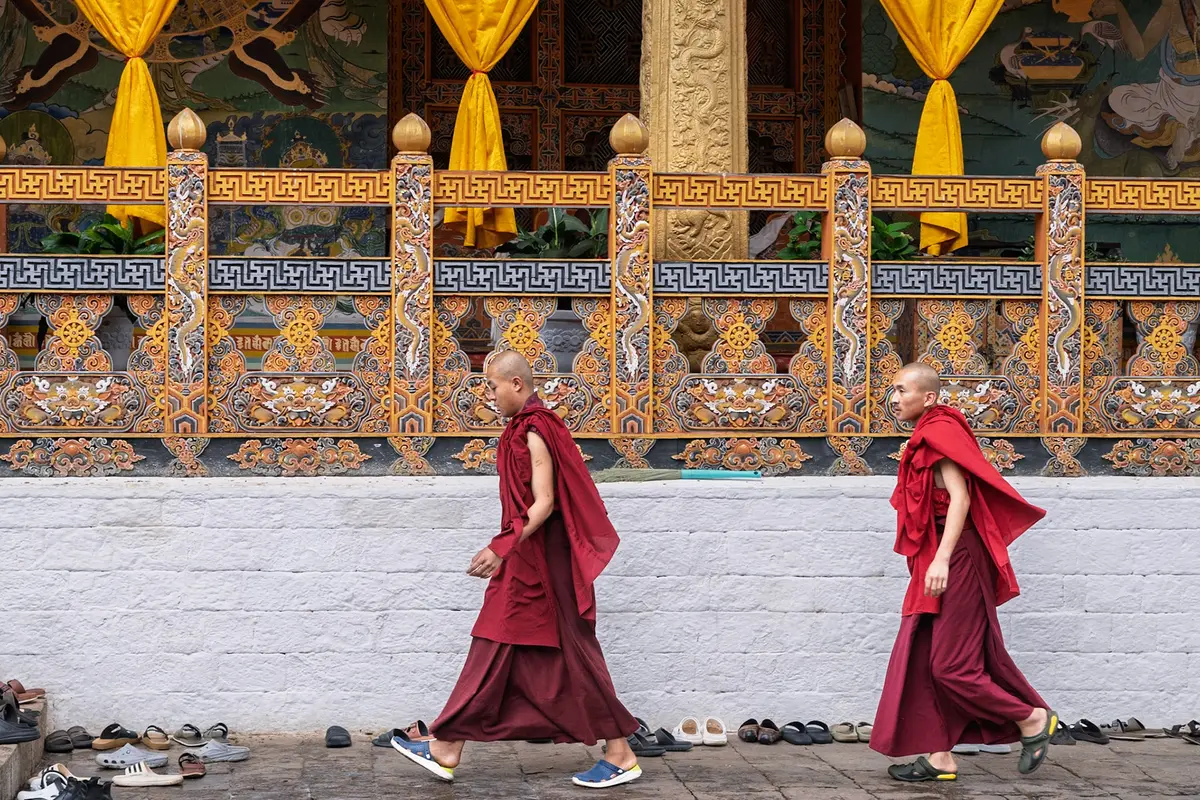
The values are legible on the ground. The forest cover is visible from every mountain road. The absence of billboards, the national dress worn in offices, the prayer flags on every pass — none of it is staged for visitors. It is what the policy looks like from inside.
For the philosophical foundation in depth, our explainer on Gross National Happiness unpacks the four pillars and nine domains, and our piece on why Bhutan is called the happiest country addresses the more complicated reality behind the headline. For travellers who want to engage with the living tradition directly rather than observe it from outside, our spiritual journeys — including the Ney Kor pilgrimage and Introduction to Buddhism — are built around exactly that.
Frequently Asked Questions
What is Buddhist diplomacy?
The use of Buddhist heritage, institutions, symbolism, and ethical vocabulary as instruments of foreign policy — including relic exchanges, pilgrimage circuits, monastic networks, sponsorship of sacred sites, museum exhibitions, and the framing of national policy in ethical language that carries authority beyond a country's material weight.
Who is Jack Meng-Tat Chia?
The Foo Hai Associate Professor in Buddhist Studies at the National University of Singapore and founding chair of its Buddhist Studies Group. He is the editor of Figures of Buddhist Diplomacy in Modern Asia (Bloomsbury, 2026), and wrote the August 2026 essay in The Diplomat that this article responds to.
How many countries does Bhutan have diplomatic relations with?
Fewer than sixty, plus the European Union — and notably none of the five permanent members of the UN Security Council, including China, with which Bhutan has never established formal relations. This selectivity is deliberate policy aimed at protecting sovereignty, not a reflection of isolation.
Did Bhutan really create the International Day of Happiness?
Effectively, yes. Bhutan sponsored UN General Assembly resolution 65/309 in July 2011 with 68 co-sponsors, arguing that GDP fails to capture human wellbeing. The Assembly then unanimously adopted resolution 66/281 in June 2012, proclaiming 20 March as the International Day of Happiness.
Why is Bhutan's relationship with Thailand significant?
It is sustained royal diplomacy between two Buddhist monarchies: King Vajiralongkorn's state visit in April 2025 (the first by a reigning Thai monarch, and his first state visit abroad), including a joint Buddhist chanting ceremony at Buddha Dordenma; an honorary doctorate for Bhutan's King from Chulalongkorn University in December 2025; and his attendance at Princess Bajrakitiyabha's funeral rites in June 2026. Ties date to 1989.
What is Gelephu Mindfulness City?
A Special Administrative Region of over 2,600 km² — about 5% of Bhutan — announced in December 2023 and chartered in December 2024, on the southern border with Assam, India. Master planned by Bjarke Ingels Group, it aims to build an economic hub governed by Gross National Happiness principles, screening investors for cultural and environmental alignment.
Isn't Gelephu Mindfulness City a contradiction of Buddhist values?
It is the most common criticism, and we think it does not hold. The first of the four pillars of Gross National Happiness is sustainable and equitable socio-economic development, so an economic project pursued under GNH is not a departure from the doctrine but an expression of it. Buddhism cautions against attachment rather than prosperity — the Middle Way explicitly rejects asceticism, and right livelihood is a limb of the Eightfold Path. Meanwhile the practical alternative is not a preserved Bhutan but a depopulated one: teachers and health workers made up close to 70% of voluntary public-sector resignations in 2024, and the country now faces over a thousand teaching vacancies and severe shortages of doctors and nurses. Bhutan made the same choice with tourism in 1974 and answered it with "High Value, Low Volume," which has protected its culture better than any neighbour's approach.
Has Bhutan ever turned down money for the sake of its values?
Repeatedly. It banned climbing above 6,000 metres in 1994 and all mountaineering in 2003 out of respect for communities who consider the peaks sacred, forgoing an entire industry and leaving Gangkhar Puensum (7,570 m) the highest unclimbed mountain on earth. It has capped tourist arrivals when more were available and held a Sustainable Development Fee high enough to measurably suppress demand.
How does Singapore's Buddhist diplomacy differ from Bhutan's?
Bhutan is a Vajrayāna Buddhist kingdom where Buddhism is embedded in monarchy, identity, and statecraft. Singapore is a secular multireligious republic that uses Buddhist heritage as one cultural resource among several, positioning itself as a connector among larger powers through monastic networks, educational initiatives such as the Nalanda revival, and museum diplomacy.
How does any of this affect me as a visitor?
Bhutan's tourism model — the Sustainable Development Fee, the licensed guide requirement, the deliberate limits on volume — is the same philosophy applied to visitors. It means a more considered, better-hosted experience, and your visit funds healthcare, education, and conservation.
Sources and Further Reading
- Jack Meng-Tat Chia, "When Small States Practice Buddhist Diplomacy," The Diplomat, 5 August 2026 — the essay this piece responds to. We recommend reading it in full; the Singapore material in particular deserves more space than we have given it here.
- *Jack Meng-Tat Chia (ed.), Figures of Buddhist Diplomacy in Modern Asia*** (Bloomsbury, 2026)
- Ministry of Foreign Affairs and External Trade, Royal Government of Bhutan — official record of the April 2025 Thai state visit and bilateral relations
- United Nations General Assembly — resolution 65/309, "Happiness: Towards a Holistic Approach to Development" (19 July 2011); resolution 66/281 establishing the International Day of Happiness (28 June 2012)
- Gelephu Mindfulness City — official project material and Royal Charter documentation
- Constitution of the Kingdom of Bhutan — Article 5, on environmental conservation and the 60% forest requirement
We are a Bhutanese tour operator, and we write about this because we think the philosophy is the point — not a marketing frame around it. If you would like to see how these ideas look from inside the country, talk to us about a journey built around them.