The Complete History of Bhutan: A Timeline from Ancient Times to Today
By Best of Bhutan Research Desk · July 30, 2026 · 28 min read
Most national histories begin with a settlement, a river, a battle. Bhutan's begins with a temple built to pin down a giantess, continues with a saint arriving on the back of a flying tigress, and includes a fifty-four-year period during which the country was ruled by a man who was secretly dead.
And here is the remarkable part: the further you get from the legends, the stranger the documented history becomes. A kingdom that was never colonized in a region where everyone was. A monarchy founded by unanimous vote. A king who fought his own people's wishes in order to give them democracy. A nation that entered the age of television in 1999 and the age of carbon accounting as the world's first carbon-negative country.
This is the full timeline — from the first valley settlers to Gelephu Mindfulness City — in more than sixty dated milestones. Use it as a reference, a reading list, or a route map: nearly every event below happened somewhere you can still stand.
Prefer to fly it rather than read it? We built this timeline as an interactive 3D map journey — Bhutan Through Time — the camera soars chronologically between the real temples, dzongs, and battlefields below. Best experienced full-screen; works beautifully on phones.
In the Beginning: Prehistoric and Ancient Bhutan (before 600 CE)
c. 2000–1500 BCE — The valleys are already home. Stone tools, megaliths, and archaeological traces suggest Bhutan's valleys were settled by at least the second millennium BCE, likely far earlier. The ancestors of groups such as the Monpa and Lhop peoples are thought to descend from these earliest inhabitants — communities that predate every temple, dzong, and dynasty that follows.
Before Buddhism — the Bon world. The early religion of the Himalayan valleys was animist and shamanic, honouring mountain deities, lake spirits, and local gods. Buddhism never erased this world; it absorbed it. The deity propitiations, ritual cairns, and spirit stories still alive in Bhutanese valleys today are its direct descendants.
Early names for a hidden land. To Tibetans, the region was Lho Mon — "the southern land of darkness" (meaning: beyond the lamp of Buddhism) — or Lho Jong Men Jong, "southern valleys of medicinal herbs." The name Bhutanese use for their own country, Druk Yul, "Land of the Thunder Dragon," would come a millennium later.
The Light Arrives: Buddhism Comes to the Valleys (7th–9th centuries)
659 CE — Two temples, one pinned demoness. The Tibetan emperor Songtsen Gampo, in the great legend, discovers a colossal demoness lying across the Himalaya, obstructing the dharma — and builds 108 temples in a single campaign to pin her down. Two stand in Bhutan to this day: Kyichu Lhakhang in Paro (pinning her left foot) and Jambay Lhakhang in Bumthang (her left knee). They are Bhutan's oldest buildings, and both are still living, functioning temples fourteen centuries later.
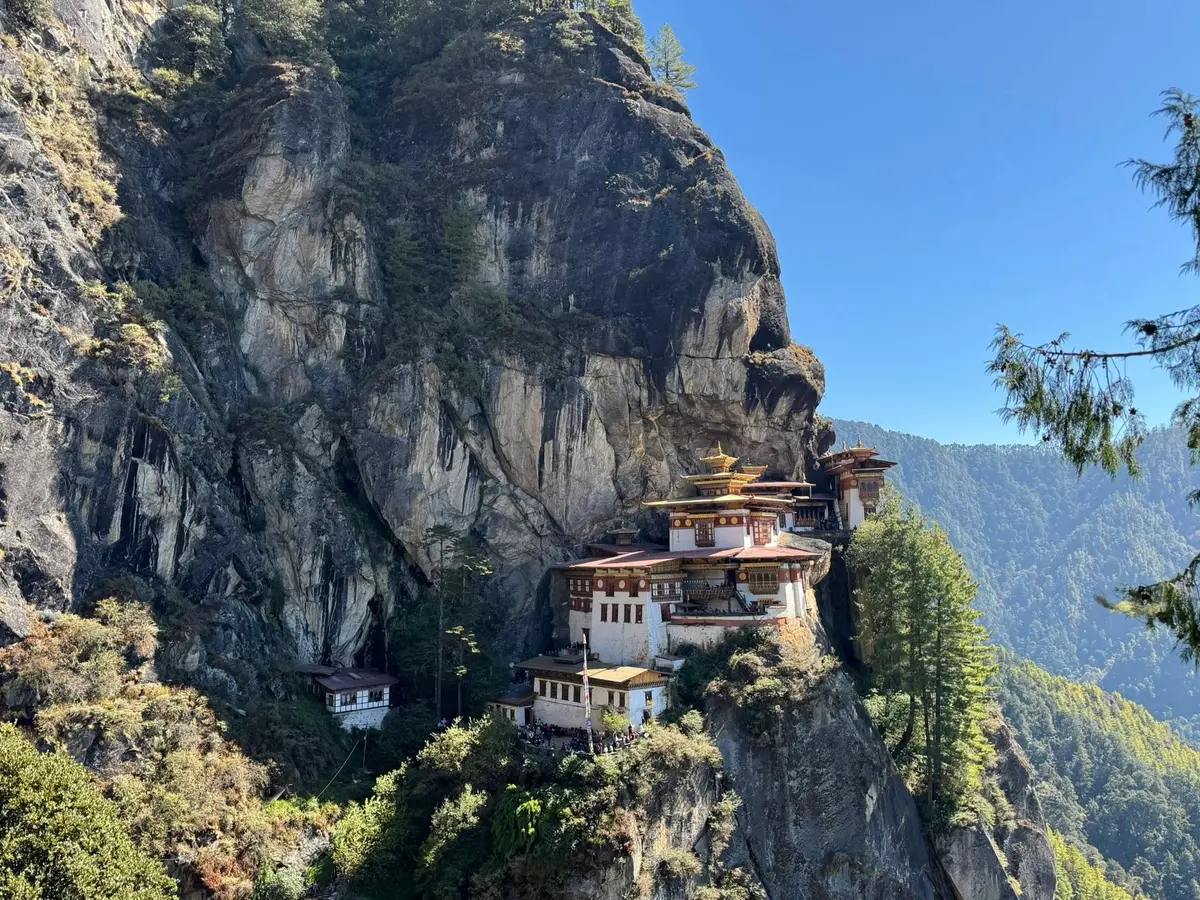
c. 746 CE — Guru Rinpoche and the flying tigress. At the invitation of Sindhu Raja, a local king of Bumthang, the tantric master Padmasambhava — Guru Rinpoche, the "Second Buddha" — arrives in Bhutan. He heals the king, subdues the local deities and binds them as protectors of the dharma, and leaves his body's imprint in the rock at Kurje Lhakhang. In the most famous act in Bhutanese sacred history, he flies to a cliff cave above Paro on the back of a tigress and meditates there — the site of the future Tiger's Nest monastery. Vajrayana Buddhism takes root in the valleys, permanently.
842 CE — Tibet's collapse sends people south. The assassination of the anti-Buddhist Tibetan emperor Langdarma shatters the Tibetan empire. In the chaos of the following centuries, waves of Tibetan migrants — many carrying their faith — settle Bhutan's valleys, layering the population and deepening its Buddhist culture.
Schools, Saints, and Iron Bridges (12th–16th centuries)
c. 1180 — A monastery named for thunder. In Tibet, the master Tsangpa Gyare founds a monastery at a site where he hears thunder — the voice of a dragon, druk. The school it births is the Drukpa Kagyu — the Dragon school. Neither the man nor the moment is in Bhutan, but the country's very name, Druk Yul, and its national identity descend from that thunderclap.
1222 — The Drukpa lineage reaches Bhutan. The lama Phajo Drugom Zhigpo arrives from Ralung in Tibet, defeats rival schools in the western valleys, and establishes the Drukpa Kagyu as the dominant tradition of western Bhutan — the religious foundation on which a state will later be built.
c. 1433 — The iron bridge builder. The engineer-saint Thangtong Gyalpo — yogi, blacksmith, and arguably the Himalaya's first civil engineer — visits Bhutan and builds iron-chain suspension bridges across its gorges. Original iron links attributed to him survive, and his most photogenic monument, Tachog Lhakhang near Paro, still stands beside a chain bridge on the road every visitor drives from the airport.
1450–1521 — Pema Lingpa, the treasure revealer. Born in Bumthang, Pema Lingpa becomes Bhutan's greatest tertön — a revealer of sacred treasures hidden by Guru Rinpoche. In his most famous act (c. 1475), he dives into the Membartsho "Burning Lake" holding a lit butter lamp and emerges with treasures — lamp still burning. He founds Tamshing Monastery (1501), and his bloodline runs forward through Bhutanese history — directly into the royal family that rules today.
1455–1529 — The Divine Madman. The saint Drukpa Kunley teaches enlightenment through outrage — wine, women, and wisdom delivered as scandal. He "creates" the takin, Bhutan's impossible national animal, from a goat's head and cow's bones, and his fertility blessing lives on at Chimi Lhakhang (founded 1499), where the phallus paintings on Bhutanese houses find their patron saint.
The Unifier: Zhabdrung Ngawang Namgyal (17th century)
1594 — A future nation is born in Tibet. Ngawang Namgyal is born at Ralung Monastery, hereditary seat of the Drukpa school.
1616 — The flight south. After a bitter dispute over his recognition as the Gyalwang Drukpa incarnation, the 23-year-old lama flees Tibet — southward, into the valleys of the dragon school. Bhutan's founding father has arrived.
1620 — Cheri Monastery. He builds Chagri (Cheri) Monastery at the head of the Thimphu valley and establishes the first body of state monks — the germ of the monastic institution that endures today.
1627 — The first Europeans. Two Portuguese Jesuits, Estêvão Cacella and João Cabral, cross into Bhutan en route to Tibet and spend months at the Zhabdrung's court — the first recorded Europeans in Bhutan. Cacella's letters describe the lama-king with fascination. Bhutan enters the Western record not as a conquest, but as a curiosity.
1629 — Simtokha Dzong. The Zhabdrung raises Simtokha, the first dzong of his new state — fortress, monastery, and administrative centre in one, built in the interlocking, nail-free style that will define Bhutanese architecture forever.
1634 — The Battle of Five Lamas. A coalition of rival Bhutanese lamas backed by Tsangpa Tibet moves against him. The Zhabdrung prevails — the decisive internal victory of unification.
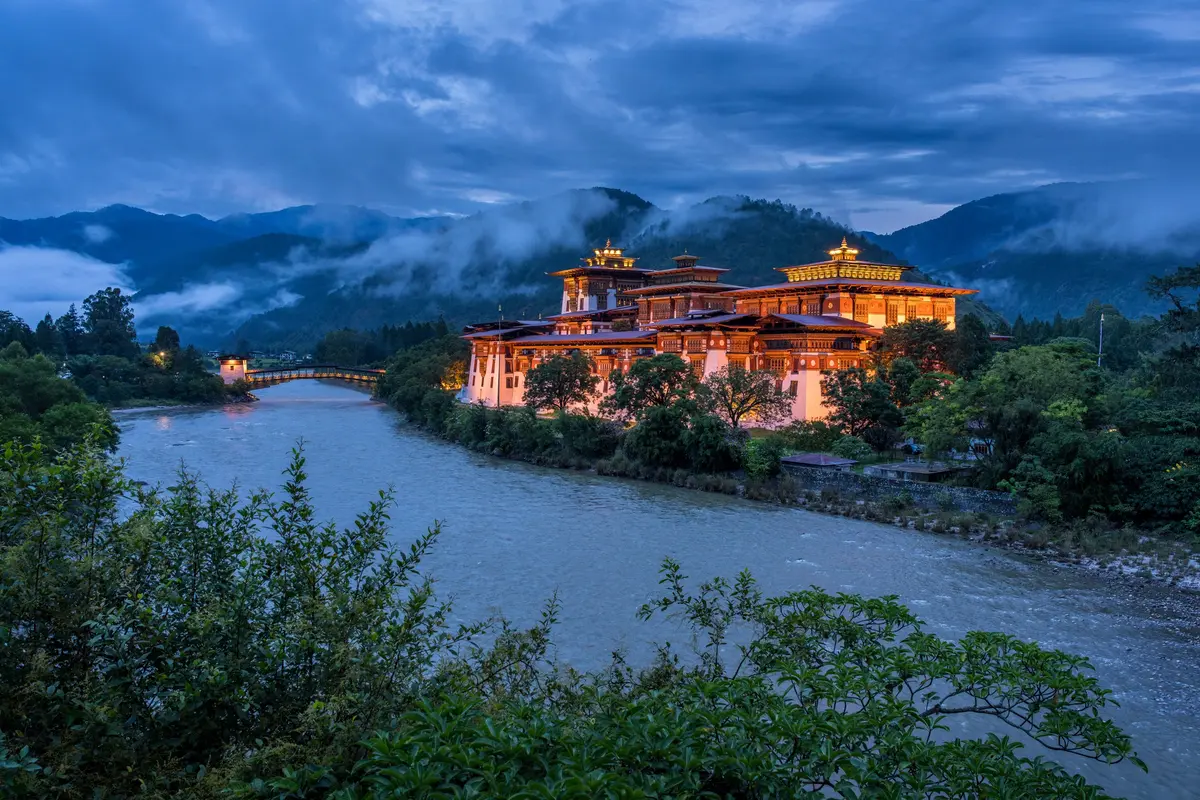
1637–38 — Punakha Dzong, the Palace of Great Happiness. At the confluence of the Pho Chhu and Mo Chhu rivers rises the most beautiful building in the kingdom: Punakha Dzong, seat of government, winter home of the monastic body, and the stage for royal weddings and coronations down to the present day.
1639–1649 — Tibet invades. Repeatedly. And fails. Tibetan, and then combined Tibetan-Mongol, armies invade Bhutan again and again through the 1640s. All fail. In celebration, the Zhabdrung builds Drukgyel Dzong — "Fortress of the Victorious Drukpa" — at the head of the Paro valley (1649). The dzongs, the driglam namzha code of conduct, the dual system of government (Je Khenpo for spiritual affairs, Druk Desi for temporal) — the architecture of the Bhutanese state is complete.
1651 — The best-kept secret in political history. The Zhabdrung dies in retreat at Punakha Dzong. His ministers, fearing the fragile new state cannot survive the news, announce that he has entered strict spiritual retreat. The secret holds for roughly 54 years — meals delivered to the chamber, decrees issued in his name — while the state he built consolidates around his absence. It is perhaps the longest successful concealment of a ruler's death ever recorded, and one of the great ghost stories of the kingdom.
Regents, Civil Wars, and the British (1651–1885)
1651–1907 — The age of the desis. For two and a half centuries, Bhutan is ruled under the Zhabdrung's dual system by a rotating cast of 54 Druk Desis — secular regents — alongside reincarnations of the Zhabdrung and the Je Khenpos. The system preserves the state but breeds chronic instability: regional governors (penlops) of Paro and Trongsa grow into rival power centres, and coups become almost routine.
1730 — Tibet mediates a civil war. Internal conflict grows severe enough that Tibet — the old invader — is invited to mediate. Bhutan's factionalism has become its greatest threat; no outside power ever manages to be.
1772–74 — First collision with the British. Bhutan intervenes in the princely state of Cooch Behar and meets the British East India Company coming the other way. After skirmishes, the 1774 peace treaty opens relations, and the Company sends George Bogle's mission through Bhutan to Tibet — the first official British mission, whose journals give the outside world its first detailed portrait of Bhutanese life.
1864–65 — The Duar War and the Treaty of Sinchula. Decades of friction over the fertile duars — the lowland passes into Assam and Bengal — erupt into war with British India. Bhutan loses the duars, and the Treaty of Sinchula (11 November 1865) cedes them permanently in exchange for an annual subsidy. It is the kingdom's greatest territorial loss — and, crucially, the end of hostilities: Bhutan bends, but is never conquered, never garrisoned, never colonized.
1870s–1881 — The Black Regent. Out of the era's chaos rises Jigme Namgyal, Penlop of Trongsa — brilliant, ruthless, and known as the Black Regent. From Trongsa's great dzong commanding the country's east–west artery, he outmanoeuvres every rival. He dies in 1881, but his son is about to end the age of chaos entirely.
1885 — The Battle of Changlimithang. At Changlimithang — today the ground of Thimphu's national stadium and archery field — Ugyen Wangchuck, son of the Black Regent, defeats his rivals decisively. Bhutan's civil wars are over. Its future first king has effectively taken power; only the title remains to be invented.
The Wangchuck Century: Monarchy and the Modern State (1885–1972)
1904–05 — The mediator knight. Ugyen Wangchuck accompanies the British Younghusband expedition to Lhasa as an indispensable mediator between empires, and is knighted for it. The penlop of a mountain kingdom has become a statesman trusted by both sides of the Himalaya.
17 December 1907 — A monarchy by unanimous vote. At Punakha Dzong, an assembly of monastic leaders, officials, and people's representatives unanimously elects Ugyen Wangchuck the first hereditary King of Bhutan — the Druk Gyalpo, crowned with the Raven Crown. Most monarchies begin with a sword; Bhutan's begins with a ballot. December 17 remains National Day.
1910 — The Treaty of Punakha. Britain agrees to guide Bhutan's external affairs while guaranteeing zero interference in internal governance — sovereignty preserved through the entire colonial age, a feat almost no other Himalayan state managed.
1926 — The second king. Jigme Wangchuck succeeds his father, consolidating the young monarchy through the world wars while Bhutan remains deliberately, profoundly closed.
8 August 1949 — Treaty with free India. Newly independent India signs a friendship treaty on the British model: guidance in external affairs, total internal autonomy — and the beginning of the special India–Bhutan relationship that anchors the kingdom's economy and security to this day.
1952 — The Father of Modern Bhutan. The third king, Jigme Dorji Wangchuck, takes the throne and begins pulling a medieval state into the modern world at extraordinary, deliberate speed.
1953 — A parliament for an absolute monarchy. He establishes the National Assembly (Tshogdu) — voluntarily creating a legislature two generations before anyone demands one.
1956 — Serfdom abolished. Feudal obligations are dissolved and land redistributed — a social revolution issued from the throne.
1958 — Nehru arrives on horseback. With no road into Bhutan, Indian Prime Minister Jawaharlal Nehru crosses the high passes from the Chumbi Valley by yak and pony to meet the king — a journey we've told the full story of. The visit cements the partnership that will fund Bhutan's modernization.
1959 — The door to Tibet closes. China's occupation of Tibet ends a millennium of cross-Himalayan religious and trade exchange overnight. Bhutan seals its northern border and turns decisively south toward India — a reorientation that defines its geopolitics to this day.
1961–62 — The first road, the first plan. Bhutan launches its First Five-Year Plan, and the first motor road climbs from Phuentsholing to Thimphu. Until this moment, everything — kings, mail, cement — moved on foot or hoof.
1964 — Assassination of the Prime Minister. Reformist PM Jigme Palden Dorji is assassinated in Phuentsholing — the gravest political crisis of the modernization era, weathered without derailing reform.
1971 — A seat among nations. Bhutan joins the United Nations, stepping formally onto the world stage on its own terms — while quietly declining, then and ever since, to exchange embassies with any permanent Security Council member.
Gross National Happiness: The Fourth King's Bhutan (1972–2006)
1972 — A sixteen-year-old king. On his father's early death, Jigme Singye Wangchuck ascends at sixteen — then the world's youngest monarch. His reign will redefine what a small country can be.
c. 1972–79 — "Gross National Happiness is more important than Gross Domestic Product." The young king's remark matures into a full governing philosophy — GNH, with its four pillars and nine measured domains — that will eventually be studied by the UN and copied nowhere successfully, because nowhere else is Bhutan.
1974 — The world is invited in (carefully). For the fourth king's coronation, Bhutan admits its first tourists — 287 of them — inaugurating the "high value, low volume" model that still governs Bhutanese tourism. The same year, the ngultrum currency is introduced, pegged to the Indian rupee.
1983 — Wings over the Himalaya. Drukair makes its first flight; Paro's spectacular runway connects the kingdom to the world by air at last.
1985 — A founding member of SAARC, as Bhutan steps into regional diplomacy.
1989 — Driglam namzha, codified. The traditional code of etiquette and dress — how to wear the gho and kira, how to conduct oneself in a dzong — is formally promoted nationwide, anchoring cultural identity as modernization accelerates. It is why Bhutan today remains one of the only countries on earth where the national dress is daily wear, not costume.
1998 — The king votes against his own power. The fourth king voluntarily devolves executive authority to an elected council of ministers — and insists on a clause allowing the National Assembly to impeach the king. The same year, fire guts the Tiger's Nest monastery; Bhutan rebuilds it by hand, exactly as it was.
1999 — Television, internet, and a plastic ban. Bhutan becomes the last country on earth to introduce television, legalizes the internet the same year — and, in the same breath, bans plastic bags. The pattern of Bhutanese modernization in a single year: enter the future, on your own terms.
December 2003 — The king leads from the front. When Assamese militant camps on Bhutanese soil defy years of negotiation, the fourth king personally leads the military operation that clears them. The 108 chortens of Dochula Pass — the most beautiful war memorial in the Himalaya — honour the fallen.
2005–06 — The abdication nobody wanted. A draft constitution circulates to every household. Then the fourth king announces he will abdicate at 51 — over widespread public dismay — to guide the transition to democracy while he still can. In December 2006, he hands the Raven Crown to his son.
Democracy and the People's King (2006–today)
2008 — The year everything changed. In a single year: Bhutan holds its first democratic general election (24 March), adopts its Constitution (18 July) — enshrining GNH, a minimum 60% forest cover forever, and mandatory royal retirement at 65 — and crowns Jigme Khesar Namgyel Wangchuck, the fifth Druk Gyalpo (6 November), in the centenary year of the monarchy itself.
13 October 2011 — A wedding at Punakha. The fifth king marries Jetsun Pema in Punakha Dzong — keeping, famously, a promise he'd made her when she was seven. The same year, a Bhutan-sponsored UN resolution puts happiness on the global development agenda.
2013 & 2018 — Power changes hands, peacefully, twice. Bhutan's second and third elections each transfer power to the opposition — the quiet, unglamorous proof that the king's democracy took root.
June 2015 — A world record, in one hour. Volunteers plant 49,672 trees in sixty minutes — a Guinness World Record, set in a country already among Earth's most forested. In 2016, the birth of Crown Prince Jigme Namgyel is celebrated by planting 108,000 more.
2020–21 — The pandemic masterclass. Bhutan closes to tourism in March 2020, holds COVID deaths to among the world's lowest, and in 2021 vaccinates over 90% of eligible adults in about two weeks — timed to auspicious astrology, delivered by volunteers to the remotest valleys on foot.
2022 — Reopening, a reborn trail, and an Oscar nod. Bhutan reopens (23 September) with a redesigned tourism model; the 403-km Trans Bhutan Trail — the old messenger route — reopens end-to-end for the first time in 60 years; and Lunana: A Yak in the Classroom earns Bhutan's first Academy Award nomination. Reports also reveal Bhutan has quietly become a significant Bitcoin miner, powered by its own hydropower.
September 2023 — The SDF is halved to US$100 per night, resetting the economics of visiting.
17 December 2023 — Gelephu Mindfulness City. On National Day, the fifth king announces the boldest project since unification itself: a ~2,500 km² special administrative region on the southern plains — an economic gateway city built on mindfulness principles, chartered into law in February 2024, with a Bjarke Ingels-designed international airport to follow near decade's end.
Today. A kingdom of under 800,000 people — never colonized, carbon negative, 70% forested, measuring happiness by law — stands with one foot in the 8th century and one in the 21st, and shows no sign of finding that uncomfortable. The history above isn't behind glass: you can stand in the 659 CE temple, walk the Zhabdrung's dzongs, trek the messenger trails, and watch the next chapter get built at Gelephu.
Frequently Asked Questions
Who founded Bhutan?
As a unified state: Zhabdrung Ngawang Namgyal, a Tibetan-born lama who arrived in 1616 and unified the valleys under the Drukpa school, building the dzong-and-dual-government system that defined Bhutan for centuries. The monarchy came later — founded by unanimous election of Ugyen Wangchuck as first king on 17 December 1907.
How old is Bhutan?
Its valleys were settled by at least 2000 BCE, its oldest standing temples date to 659 CE, and the unified Bhutanese state dates to the 1620s–1640s. The monarchy is young by comparison — founded in 1907 — and democracy younger still, born in 2008.
Was Bhutan ever colonized?
No — uniquely in its region. Bhutan lost the duars to British India in the 1865 Treaty of Sinchula and accepted British guidance of external affairs in 1910, but no foreign power ever governed, garrisoned, or administered Bhutan internally.
What is the oldest building in Bhutan?
Kyichu Lhakhang in Paro and Jambay Lhakhang in Bumthang, both traditionally dated to 659 CE and attributed to the Tibetan emperor Songtsen Gampo's legendary 108-temple campaign. Both are still active temples.
When did Bhutan open to tourists?
1974 — the year of the fourth king's coronation — when the first 287 tourists were admitted. Tourism has followed a deliberate "high value, low volume" policy ever since.
Why was the Zhabdrung's death kept secret for 54 years?
His ministers feared the young, fragile state would fracture or invite Tibetan invasion if his death (1651) became known. The retreat fiction held long enough for Bhutan's institutions to outgrow their founder — arguably the most successful political secret ever kept.
When did Bhutan become a democracy?
2008, by royal insistence: first general election on 24 March, constitution adopted 18 July. The fourth king had voluntarily begun devolving power a decade earlier and abdicated in 2006 specifically to oversee the transition.
History is better walked than read. Stand in the 7th-century temples of Bumthang, cross the Zhabdrung's Punakha Dzong, and hike to the cave where it all began at Tiger's Nest — our cultural tours thread the whole timeline into one journey. Start with the visa guide, or talk to our team.