Local Deities of Bhutan: Gods of Mountains, Valleys and Lakes
By Best of Bhutan Research Desk · October 26, 2026 · 14 min read
Ask a Bhutanese friend where they are from and you may also learn who protects them. In Haa, it is Ap Chhundu. In lower Thimphu, it is Ap Genyen Domtshang of Changangkha. In Paro, it is Jowo Drake, the deity of the peak that rises above the valley's northern end. Bhutan's Buddhism sits on top of a much older layer of belief: every mountain, valley, lake, cliff and large tree has an owner, and that owner expects to be respected.
These are Bhutan's local deities. They are not the Buddhas and bodhisattvas you see on temple altars. They are worldly beings tied to a place, who protect the people living there, bring rain and good harvests, and can cause illness or bad luck when ignored or offended.
In short: local deities in Bhutan are called yul lha (gods of the territory) and zhi dag (lords of the place). Many are also kye lha, birth deities of everyone born in their area. Most are said to have been bound by oath to protect the Dharma by Guru Rinpoche in the 8th century. Villages honour them with annual offerings and festivals, and some mountains and lakes are left untouched out of respect for them. Bhutan's ban on mountaineering is partly rooted in this belief.
Interactive Map: Who Protects Each Valley?
The map below pins twelve deities from Jomolhari in the west to Merak in the east. Filter by type, tap a pin to fly to the deity's mountain or shrine, or press Take the tour to travel across the country from west to east.
What Are Local Deities in Bhutan?
The two main terms are:
- Yul lha (ཡུལ་ལྷ་), "gods of the territory". A yul lha guards a wider area, such as a valley or a group of villages.
- Zhi dag (གཞི་བདག་), "lords of the settlement" or of the ground. A zhi dag is tied to a specific village or site.
Both are also called ne dag zhi dag or simply nep, "the host", according to a reference on local deities published by the University of Virginia's Mandala library. The idea is that the deity is the original owner of the land and humans live there as guests.
The French Tibetologist Françoise Pommaret, who has written widely on the subject, describes the yul lha as ruling a territory whose boundaries villagers can point to exactly. A powerful regional deity may hold sway over several valleys, with smaller deities below it, down to minor deities for a single cluster of houses.
Bhutanese address their local deities with family terms that show closeness rather than distance: ap or papa (father), ama (mother), agay (grandfather), ashi and jowo (lord). That is why so many names begin with Ap or Jomo.
Birth deities (kye lha)
Many local deities are also kye lha (སྐྱེས་ལྷ་), birth deities. A person's kye lha is the deity of the place where they were born, and that link lasts for life, wherever they move.
Thimphu shows how precise this can be. Writer Dorji Wangchuk explains that the Chubachu stream divides the city between two birth deities. Children born south of it, in lower Thimphu, belong to Ap Genyen Domtshang of Changangkha Lhakhang. The national referral hospital is in his area, so most babies born in the capital do too. Children born north of the stream, in upper Thimphu, belong to Genyen Jagpa Melen of Dechenphu Lhakhang.
Worldly protectors, not Buddhas
Bhutanese Buddhism separates enlightened protectors (yeshe kyi lha) from worldly deities (jigten pa'i lha). Local deities are worldly. They are powerful but not enlightened, and they have moods. People turn to them for practical things such as health, children, safe travel, rain and success in an exam, an archery match or a new business, not for liberation.
Some local deities hold a higher rank. Genyen is a title Guru Rinpoche is said to have given to 21 local deities after they received his teaching, and Dorji Wangchuk describes them as half-enlightened. Genyen Jagpa Melen is the best known in Bhutan.
Types of Spirits and Deities
The land is crowded. Alongside the named yul lha, Bhutanese tradition recognises several classes of beings, each with its own habitat and temperament. The list below draws on the Mandala library reference and on research by David Hecht and Gyempo Wangchuk for Terralingua.
| Being | Where it lives | Character |
|---|---|---|
| Lha | Mountains and high places | The broad term for gods. Yul lha are lha of a territory |
| Tsen (btsen) | Cliffs and rocks | Red, fierce and quick to anger. Many village deities are tsen, such as the many "Tsen" names in Mongar |
| Lu (klu) | Underground, springs, rivers and lakes | Water spirits. Polluting water or disturbing a spring is believed to anger them and cause skin disease |
| Dü (bdud) | Various | Dangerous, wrathful spirits. In some traditions they are deliberately not depicted |
| Gyalpo | Various | "Possessive, temperamental and demanding of timely offerings and respects" |
| Sadag | The earth itself | Lords of the soil, consulted before ground is broken for a house |
| Nep (gnas po) | A specific locality | The "host" or landlord deity of a place |
| Khandro (dakini) | Sky, caves and sacred sites | Female "sky-goers" who receive offerings |
The same Mandala reference lists many more (damsri, dre, srinpo, shindre, tshomen, menmo, theurang), most of them harmful spirits that rituals keep at bay. Our Haunted Bhutan explorer covers some of the ghost stories that go with them.
How Guru Rinpoche Bound the Local Gods
The standard account is that these deities lived in Bhutan before Buddhism arrived and were hostile to it. In the 8th century, Guru Rinpoche (Padmasambhava) travelled through the Himalaya subduing them and binding them by oath to protect the Dharma and the people of their land. Later Bhutanese masters, including the Zhabdrung, renewed these oaths.
The best-known Bhutanese example is at Kurjey Lhakhang in Bumthang. Wikipedia's account of the legend runs like this. King Sindhu Raja of Bumthang lost his son in war, and when his prayers went unanswered he destroyed the shrines of the local gods. In revenge, the deity Shelging Karpo stole the king's sog, his life force, and the king fell ill. Guru Rinpoche was invited from Nepal. He performed a dance that drew out every local deity except Shelging Karpo, who stayed hidden in his cave. The Guru finally lured him out with sunlight reflected from a copper vase, subdued him and made him a protector. The king recovered, and the cave where the Guru meditated still holds the imprint of his body, which gave Kurjey (body print) its name.
This pattern repeats across the country: a fierce local power, a struggle, and a new role as guardian. It explains why local deities have shrines inside Buddhist temples and dzongs, often in a separate protector chapel called the goenkhang.
Local Deities of Western Bhutan
Jomo of Jomolhari
Jomolhari (7,326 m), on the border between Paro and Tibet, is believed to be the home of one of the Five Tsheringma Sisters, the goddesses of long life who are revered as protectors in the Kagyu and Nyingma schools. Wikipedia notes that they are known as Jomo, female protector goddesses of Tibet and Bhutan, and that Padmasambhava bound them by oath. Bhutanese often call the mountain's goddess Ama Jomo.
Each sister grants something different. Dorji Wangchuk's guide to the Tsheringma sisters lists them, with their mounts, as:
- Tashi Tsheringma, on a snow lioness, who grants long life
- Thinggi Shyal Zangma, on a mare, for victory and safe journeys
- Talkar Dro Zangma, on a dragon, for health and for children
- Miyo Lang Zangma, on a tiger, for prosperity and good harvests
- Choepen Drin Zangma, on a doe, for wealth and wishes fulfilled
He also notes that each sister has a site in Paro, including Drangoe Gonpa and Paro Gangtey Lhakhang. On the Jomolhari trek, a small Jomolhari temple sits below the peak, and the lake Tseringma Lhatso is within an hour's walk above it.
Jowo Drake of Paro
Jowo Drake (also Jichu Drake) is the tutelary deity of Paro and its surroundings. He lives on the peak of the same name north of the valley. According to Wikipedia, a local story explains the mountain's double summit: a young girl struck Jowo Drake on the head with a weaving tool after he teased her.
A day hike from Bjana leads to Drakey Pangtsho, a treasure lake on the slopes of his mountain at about 4,390 m. Bhutan Pilgrimage records the belief that Jowo Drake offered the lake to Guru Rinpoche to hold sacred treasures. Pilgrims ask visitors not to pour milk into the lake and to take care with fire when burning incense.
Ap Chhundu of Haa
Ap Chhundu is the guardian of the Haa valley and the birth deity of everyone born there. He is seen as a manifestation of Chana Dorji (Vajrapani). At Chhundu Lhakhang, about 11 km north of Haa town, the blue-faced Ap Chhundu stands beside his red-faced cousin Jowya at the main altar, according to Little Bhutan.
His legend links three valleys. The Zhabdrung is said to have banished him to Haa after a fight with Ap Genyen, the protector of Thimphu. In Haa he then quarrelled with Paro's Jowo Drake and lost. In the local telling, Paro took Haa's water, which is why the upper Haa valley grows no rice. (The practical reason is that upper Haa, at around 2,700 m, is too high and dry for paddy.)
Ap Chhundu also shows how offerings change. Haa held an annual offering day for him that starts before dawn at Lhakhang Karpo, his main shrine. Until 2013 a yak was slaughtered and offered every year. The practice ended after the deity's permission was sought by throwing dice, and the answer was read as yes. See our Haa valley page for more on visiting.
The guardians of Thimphu
Thimphu has two major protectors, split by the Chubachu stream as described above.
- Genyen Jagpa Melen lives at Dechenphu Lhakhang, about 20 minutes' drive north of town. Bhutan Pilgrimage calls him "the powerful guardian deity of Bhutan" and the principal protector of the Drukpa Kagyu school. Bhutanese visit before starting a new job, venture or journey. His life lake, Geynyen Latsho, is a seven-hour hike from the temple. International tourists may not enter the goenkhang, but you can see the exterior and the one-day Dechenphu Tshechu, held on the 10th day of the 9th Bhutanese month.
- Ap Genyen Domtshang lives at Changangkha Lhakhang, probably the oldest temple in the Thimphu valley, on a ridge above the city. He is the territorial lord of Thimphu, and people pray to him for protection against bad dreams and harmful spirits. Changangkha is a popular temple for parents of newborns.
Local Deities of Central Bhutan
Shelging Karpo of Bumthang
The deity subdued at Kurjey, as told above. Kurjey Lhakhang in the Chokhor valley is one of the most important pilgrimage sites in Bhutan and a standard stop on any trip to Bumthang.
Lhé Wangpo Gyajin and the Lhabön of Chendebji
In Chendebji village in Trongsa district, on the road between Wangdue and Trongsa, the local deity Lhé Wangpo Gyajin is honoured every year with Lhabön, documented by Sonam Chophel of the Shejun Agency. The three-day festival in the 10th lunar month is held to dispel misfortune:
- Day 1: a Bönpo (a village priest of the pre-Buddhist tradition) leads a procession that escorts the deity from its mountain home to a temporary bamboo shrine, the lhachim. Bangchang, a local brew, is offered in welcome.
- Day 2: two large wooden phalluses are raised onto the roof of the shrine and later lowered. The atsara clowns then use them to entertain the crowd.
- Day 3: the deity is returned to its mountain, with songs and a drum dance. Two days of archery follow.
Rites like this, led by lay priests rather than monks, show how much of Bhutan's local religion predates Buddhism and carries on alongside it. Our guide to the atsara festival clown explains the phallus symbol.
Gangkhar Puensum: the mountain no one climbs
At 7,570 m, Gangkhar Puensum is Bhutan's highest mountain. Its name means "White Peak of the Three Spiritual Brothers". BhutanWiki notes that four expeditions failed in 1985 and 1986, which locals put down partly to the deities' displeasure.
Bhutan banned climbing peaks above 6,000 m in 1994 and has prohibited all mountaineering since 2003, according to Wikipedia. Respect for the mountain deities is a large part of the reason, so Gangkhar Puensum is often called the highest unclimbed mountain in the world. You can see it from high passes on the Snowman trek.
Local Deities of Eastern Bhutan
Lhang Zhong Kunzang Drakden of Mongar
The National Museum of Bhutan has been documenting local deities district by district in its Guardian Deities series. The Mongar volume lists dozens, many of them tsen. One example is Lhang Zhong Kunzang Drakden, the birth deity of the people of Wengkhar Chhuzhi. Households make offerings to him at home on annual and auspicious days. In hard times the community prays at his shrine to protect livestock and crops and to bring rain.
Takila Chha in Lhuentse
In Lhuentse, the four-day Takila Chha begins on the evening of the 13th day of the 7th month, Sonam Chophel reports. It honours the village heads Wokhor Zhelngo and Kharshong Zhelngo, Chammi, the local deity of Kusunphel village, and the protectors Gonpo and Gonmo (Mahakala and Mahakali). On the second day a Chammi chosen from one family is escorted to a large cypress tree, offered food, drink and fish, entertained with Bro dances, and blesses the community. A pig was once sacrificed on the last day. Today about five kilograms of pork, cut into 100 pieces, is offered instead with fruit and wine.
Shawang Labsten of Bomdeling
In Bomdeling in Trashiyangtse, a resident lama told Terralingua's researchers that the Bön deity Shawang Labsten is invoked every year at a cypress tree near the village. In his telling, the valley's host deity once diverted a river and flooded the land into a lake until a garuda burst it. Villagers put the local rule simply: "there is an owner, a caretaker, for each stone, for each tree, and for the water around us." Building near a deity's seat is avoided, and so is a road towards one. Bomdeling is also the winter home of black-necked cranes, a short drive north of Chorten Kora.
Jomo Kuengkhar of Merak and Sakteng
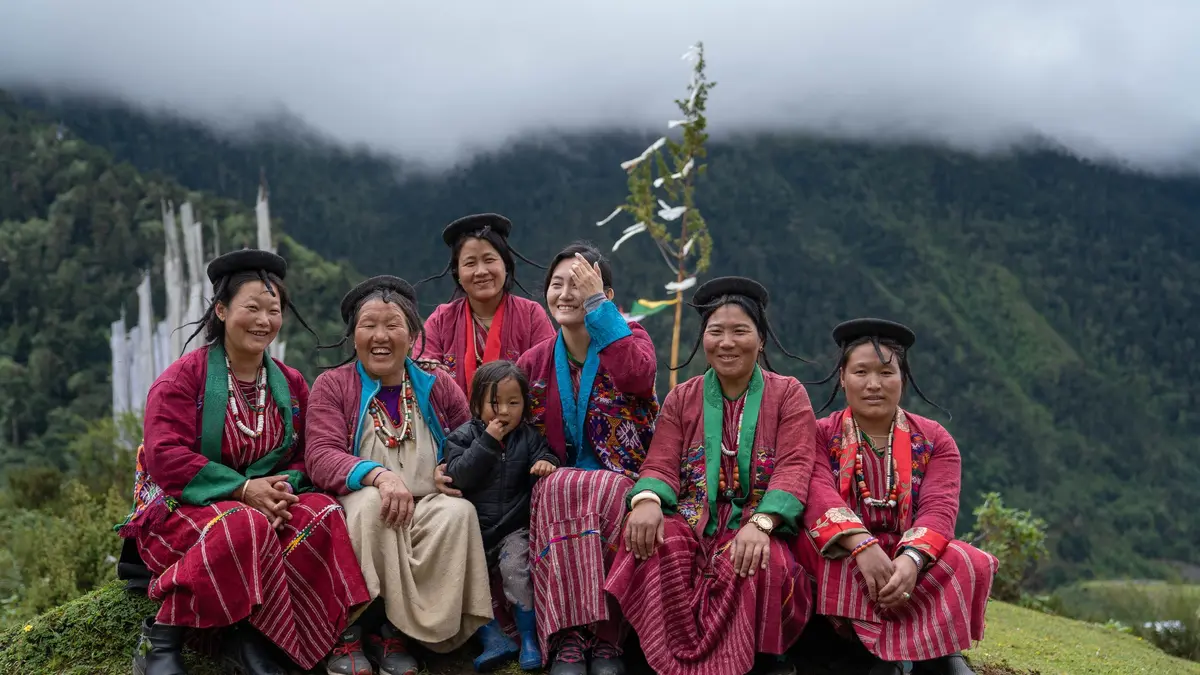
The semi-nomadic Brokpa yak herders of Merak and Sakteng in Trashigang have their own deities. Daily Bhutan records that a deity, Aum Jomo, together with Lam Jarepa, guided the Brokpa through the mountains to Bhutan, and that every autumn they hold a two-day festival for the mountain goddess Jomo Kuengkhar to ask for prosperity. The Merak to Jomotshangkha trek passes through Brokpa country.
How Bhutanese Honour Their Local Deities
The relationship is one of mutual obligation. The deity protects the land and its people, and the people keep the deity fed and respected. According to the Mandala library reference and the Terralingua research, it shows up in:
- Seasonal and annual offerings. Villages invite the deity to a feast once a year on a date set by the lunar calendar. Typical offerings are torma (ritual cakes), fruit, milk and alcohol, with ritual trumpets and drums. A serkyem (golden drink) libation is a common daily or occasional offering.
- Household rites. Families include the local deity in their annual household ritual and make offerings on auspicious days.
- Daily offerings by village priests at the deity's shrine.
- Prayers before big moments. Before a journey, a new project or an exam, and during archery matches, Bhutanese call on their deity. Dechenphu's Genyen Jagpa Melen is the classic choice for new ventures.
- Festivals like Lhabön and Takila Chha that escort the deity down from its mountain, entertain it and return it.
- Changes over time. Animal sacrifice has largely given way to other offerings, from Haa's yak in 2013 to Takila's pork pieces. Where the change is made by asking the deity's permission, as in Haa, the relationship stays intact.
Sacred Nature: Why Some Places Are Left Alone
Because local deities live in the landscape, the belief has a direct effect on how land is used:
- Mountains. Bhutan's ban on mountaineering protects the high peaks that are home to deities such as Jomo and the three brothers of Gangkhar Puensum.
- Lakes and springs. Many lakes are tsho of deities or lu, and swimming, fishing or polluting them is avoided. Pilgrims at Drakey Pangtsho ask visitors not to pour milk into the water.
- Forests, trees and rocks. Some sites are closed to woodcutting or entry, permanently or for part of the year. In Bomdeling, sitting on a sacred tree or stone is believed to harm the spirit inside, which may harm you back.
- Construction. The sadag and lu are consulted before ground is broken. A ground-breaking ceremony is standard for new buildings in Bhutan, and building near a deity's citadel is avoided.
Researchers sometimes call these sites "deity citadels" and point to them as one reason Bhutan has kept so much of its forest. For more on Bhutan's protected landscapes, see our guide to Bhutan as a biodiversity hotspot.
Etiquette for Visitors
You do not need to take part in anything, but a few habits show respect:
- Follow your guide inside temples. Many temples have a goenkhang for the protectors. Some, like Dechenphu's, are closed to foreign visitors, and in others women may be asked not to enter. Photography is not allowed inside temples in Bhutan.
- Leave lakes, springs and sacred rocks as they are. Don't swim in, wash in or throw things into lakes unless your guide says it is a local custom.
- Don't sit or climb on shrines, sacred trees or decorated rocks, and don't take stones or branches from them.
- Walk clockwise around temples, chortens and sacred sites.
- Ask before joining a village rite. Festivals such as Lhabön are community events. Your guide can find out whether visitors are welcome and how to behave.
- Dress modestly for any temple or dzong visit. Our kabney and rachu guide explains what Bhutanese wear and what visitors should wear.
Where to Experience Bhutan's Local Deities
- Thimphu: Changangkha Lhakhang and Dechenphu Lhakhang, plus Dechenphu Tshechu in the 9th lunar month.
- Paro and Haa: the Drakey Pangtsho day hike below Jowo Drake, Lhakhang Karpo and Chhundu Lhakhang in Haa, and the Jomolhari trek for Ama Jomo.
- Bumthang: Kurjey Lhakhang and the Kurjey Tshechu in summer.
- Trongsa: Chendebji, on the main road east.
- The east: Mongar, Takila in Lhuentse, Bomdeling in Trashiyangtse, and Merak and Sakteng. Our eastern Bhutan guide covers routes and timing.
- Festivals: most dzong tshechus include dances for the protectors. Check dates in our festival calendar.
Frequently Asked Questions
What is a yul lha?
A yul lha is a "god of the territory", a local deity who owns and protects a valley or area. Villagers know its boundaries and make offerings to it for protection, rain and good harvests.
What is the difference between yul lha and zhi dag?
Yul lha guard a wider territory, such as a valley. Zhi dag are "lords of the place", tied to a particular village or site. Both are sometimes called nep, the host deity.
What is a birth deity (kye lha)?
A kye lha is the deity of the place where a person was born. The link lasts for life. In Thimphu, people born south of the Chubachu stream belong to Ap Genyen Domtshang of Changangkha, and those born north of it to Genyen Jagpa Melen of Dechenphu.
Who is the guardian deity of Bhutan?
Genyen Jagpa Melen of Dechenphu Lhakhang is often described as the most powerful guardian deity of Bhutan and the main protector of the Drukpa Kagyu school. Each valley also has its own protector.
Are local deities part of Buddhism?
They predate Buddhism in Bhutan, but they have been absorbed into it. Tradition says Guru Rinpoche bound them by oath to protect the Dharma, so they are now worldly protectors with shrines in many temples and dzongs.
Why is mountaineering banned in Bhutan?
Bhutan banned climbing above 6,000 m in 1994 and all mountaineering in 2003. Respect for the deities believed to live on the high peaks is a main reason. Gangkhar Puensum (7,570 m) remains unclimbed.
Can tourists visit the temples of local deities?
Yes, most are open to visitors with a guide. Some protector chapels (goenkhang) are closed to foreign visitors, including the one at Dechenphu Lhakhang. Photography inside temples is not allowed.
Who is Ap Chhundu?
Ap Chhundu is the guardian deity and birth deity of the Haa valley. Legend says he lost a quarrel with Paro's deity Jowo Drake, which is why upper Haa grows no rice.
Sources
- National Museum of Bhutan, Guardian Deities of Mongar Dzongkhag, Guardian Deities series
- Mandala, University of Virginia, Yullha and Zhidak: Two Types of Local Deities
- Sonam Chophel (Shejun Agency), Lhabön Festival in Chendebji, Trongsa
- Sonam Chophel (Shejun Agency), Takila Chha: A Festival in Lhuntse
- Françoise Pommaret, Yul and Yul Lha: The Territory and Its Deity in Bhutan
- David Hecht with Gyempo Wangchuk, Painting the Unseen, Terralingua
- Dorji Wangchuk, The birth deity of Thimphu and Tshering Chenga: The Tsheringma Sisters
- Bhutan Pilgrimage, Dechenphu Lhakhang and Drakey Pangtsho
- Little Bhutan, Chhundu Lhakhang
- Daily Bhutan, Tribes of Bhutan: The Brokpas
- BhutanWiki, Sacred Mountains of Bhutan
- Wikipedia, Kurjey Lhakhang, Jomolhari, Jitchu Drake and Gangkhar Puensum
Local tellings of these stories vary from village to village. If you know a version from your own valley, please get in touch.
Want to visit the temples and sacred lakes of Bhutan's local deities? Talk to us about a cultural or pilgrimage itinerary that includes Haa, Bumthang or the east.