Project 108: Gelephu Raises 108 Stupas on November 1
By Best of Bhutan Research Desk · October 8, 2026 · 8 min read
Project 108, the royal initiative to raise 108 stupas in Gelephu in a single day, takes place on 1 November 2026. BBS reported on 8 October that about 84,000 people have already registered to attend, organisers expect around 100,000, and most of Gelephu's hotels are nearly full. A second BBS report the same day said more than 30,000 vehicles have registered to make the trip, and police have announced road restrictions, parking zones and shuttle services for the week of the event.
The stupas are Jangchub Chortens (stupas of enlightenment), each 15 metres tall, built along the Mao Chhu river in Gelephu Mindfulness City (GMC) in southern Bhutan. GMC Governor Dasho Dr Lotay Tshering told BBS that "Bhutan has not seen a gathering of this scale."
In short: if you are in Bhutan in late October or early November, expect heavy traffic on the routes into Gelephu, full hotels in the south, and road closures around 30 October to 4 November. If your itinerary is in western and central Bhutan (Paro, Thimphu, Punakha, Bumthang), the main effect is busier roads south of Wangdue and Tsirang.
Key Facts at a Glance
| Detail | What has been announced |
|---|---|
| Event | Project 108 — raising of 108 Jangchub Chortens |
| Date | 1 November 2026 |
| Location | Along the Mao Chhu river, Gelephu Mindfulness City, Sarpang district |
| Stupa height | 15 metres each |
| Spacing | 108 metres apart |
| Registered attendees | About 84,000 (BBS, 8 October) |
| Expected attendance | About 100,000, including guests from around 20 countries |
| Vehicles registered | More than 30,000 |
| Je Khenpo arrives | 21 October, for prayers and blessing rituals before the event |
| Private vehicles barred from town | 1–4 November |
| Gelephu border gate | Closed on 1 November |
| Help line | Toll-free 108 |
What Project 108 Is
His Majesty The King announced Project 108 as a royal initiative in February 2026, BBS reported in May. The plan is to build all 108 chortens at once, on one day, as a collective offering and prayer. Buddhistdoor's Tea House reported that His Majesty the Fourth King addressed the nation on 21 February to invite contributions, and that digging along the riverbank began the same month.
The chortens sit on a ridgeline above the Mao Chhu (also written Maukhola), inside the GMC special administrative region. GMC is the large new city Bhutan is developing on its southern border with Assam. For background on the city itself, see our Gelephu geography explainer and our Gelephu destination page.
See it in 3D: our interactive Jangchub Chorten model shows how each of the 108 stupas is built, element by element.
Why 108
The number has a specific meaning in Bhutanese Buddhism. According to BBS, it represents the 108 afflictive emotions, which is also why prayer beads have 108 beads. The Kangyur, the collected teachings of the Buddha, runs to 108 volumes.
There is also a Bhutanese precedent. In the 7th century the Tibetan king Songtsen Gampo is said to have built 108 temples across the Himalaya in one day. Two of them still stand in Bhutan: Kichu Lhakhang in Paro and Jambay Lhakhang in Bumthang, both regular stops on cultural tours. Project 108 repeats that idea at a much larger scale.
Who builds the stupas
Earlier coverage, including Luxurious Magazine in June, described at least 40,000 trained volunteers working across all 108 sites. The most recent BBS report adds a clarification: the people attending on 1 November will not build the stupas themselves. Tashi Penjor, Managing Director of City Development at the GMC Administration, told BBS that trained teams of builders will do the construction, because having thousands of volunteers build at once would not be practical.
Relics and consecration
The inner relics that go inside each chorten have been in preparation for about four months. A BBS report from 29 September said the Zhung Dratshang (Central Monk Body) had completed about 99% of the work, and a 21-day consecration (rabney) of the relics began in late September, led by former Drabi Lopen Sangay Dorji. His Holiness the Je Khenpo is expected in Gelephu from 21 October to lead further prayers and blessing rituals. Eight galleries are planned for spiritual masters and monks to perform rituals on the day.
Sponsorship
Luxurious Magazine reported that individual chortens could be sponsored for about US$200,000, and that individuals and organisations abroad can contribute through a crowdfunding platform run by the Royal Securities Exchange of Bhutan. Details are on the official Project 108 page.
Road Closures, Parking and Shuttles
The traffic plan is the part that affects the most people. According to the Royal Bhutan Police briefing reported by BBS:
- From 20 October: police will monitor vehicle movement closely, using portable speed cameras, automatic number plate recognition and body cameras.
- 30–31 October: no vehicles may travel from Gelephu towards Thimphu.
- 1 November: the Gelephu border gate with India will be closed.
- 1–4 November: private vehicles cannot enter Gelephu town, and movement inside town will be restricted.
- Shuttles: about 100 buses and 1,500 taxis will run between parking areas and the city.
Designated parking areas:
| Arriving from | Park at |
|---|---|
| Sarpang | Tashiling (pick-up and drop-off service) |
| Serzhong | Pelrithang |
| Umling and Taraythang | Near the nunnery below Norbuling Primary School |
| Campers | Campsite behind the Gelephu Fishery Farm; parking near the sewage plant |
Of the registered vehicles, about 22,000 are expected to use the Indian highway and more than 9,000 the domestic route from Thimphu via Tsirang. Police have asked people to carpool. Drivers using the Indian highway are reminded to wear seatbelts and carry Indian rupees for highway fees.
What It Means for Travellers
Can international tourists attend? This is not yet clear. The BBS traffic report says entry will be limited to invited guests, Bhutanese nationals and friends of the Bhutan-India Friendship Association. It does not say whether tourists on a standard Bhutan visa can attend as spectators, and we have not found an official statement either way. Organisers say guests from around 20 countries are expected, but these appear to be invited guests and sponsors. Treat attendance as unconfirmed and ask your tour operator before building a trip around it.
Hotels in Gelephu are close to full. BBS reported that most of Gelephu's 62–63 hotels are nearly fully booked, with some rooms reserved five to six months ahead. If your route passes through the south in the first week of November, book early or plan to stay elsewhere.
Expect delays on the southern routes. The Thimphu–Wangdue–Tsirang–Gelephu road will carry thousands of extra vehicles in the last week of October, and travel from Gelephu northbound is closed on 30–31 October. If you planned to enter or leave Bhutan overland through Gelephu, the border gate closure on 1 November and the town restrictions to 4 November mean you should reroute or reschedule. Phuentsholing and Samdrup Jongkhar remain the alternatives; see our post on the Phuentsholing 24-hour SDF waiver for the rules on that crossing.
Western Bhutan is largely unaffected. Paro, Thimphu, Punakha and the Tiger's Nest hike are a long way from Gelephu. Early November is peak autumn season with clear skies, so if you are already booked for those areas, keep your plans. Our month-by-month guide covers what to expect, and our festivals guide lists the tsechus held around the same time.
Visit the stupas later. Once raised and consecrated, the 108 chortens become a permanent site in GMC. A visit after the crowds have gone is a more practical option for most travellers, and could be combined with the Sarbang sacred sites near Gelephu. Visitors pay the standard Sustainable Development Fee, and need a Bhutan visa arranged in advance.
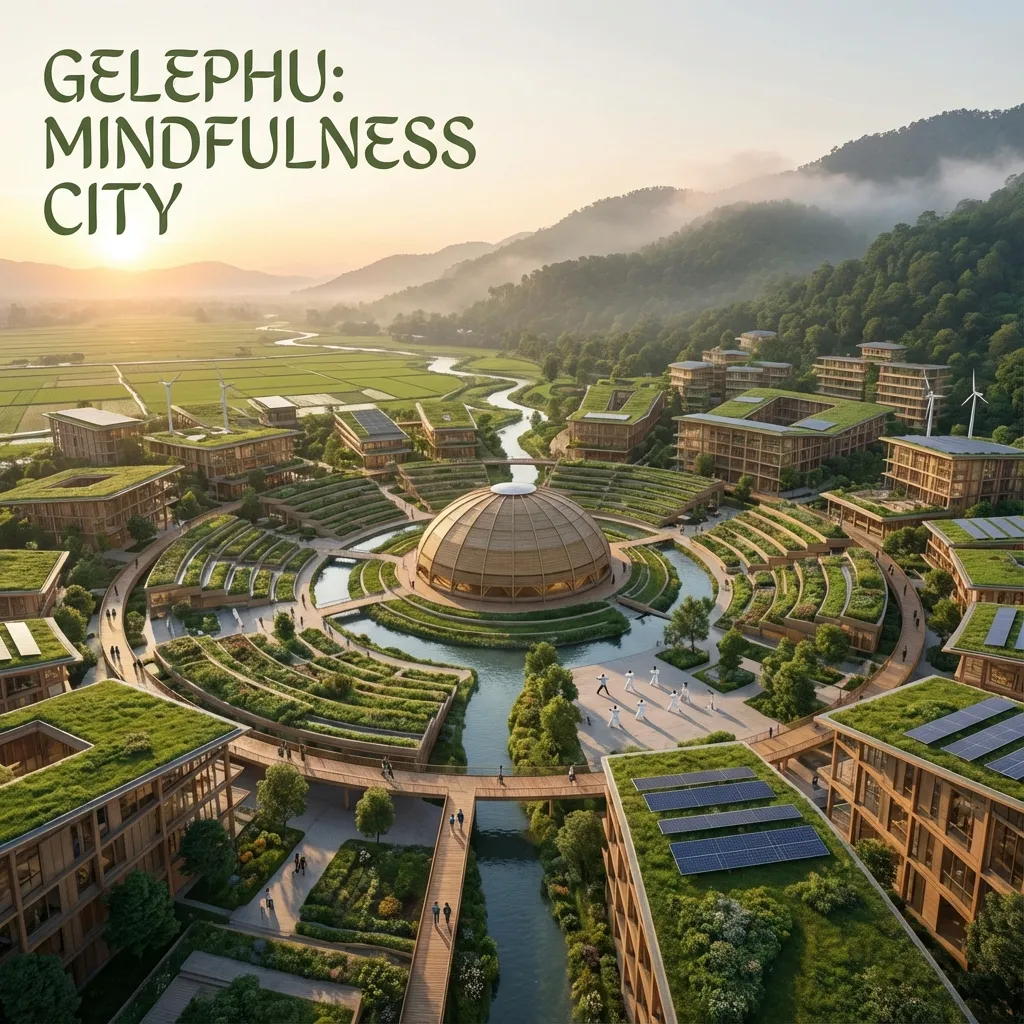
An artist's concept of Gelephu Mindfulness City. This is an illustration, not a photograph of the Project 108 site.
The Bigger Picture for Gelephu
Project 108 is the largest public event yet held in Gelephu Mindfulness City, and it comes as the city's other infrastructure moves forward. The airfield construction contract for the planned Gelephu International Airport was awarded on 3 October; we covered it in Gelephu International Airport: airfield contract awarded. For what is confirmed and what is only proposed for the wider city, see our Gelephu Mindfulness City explainer.
For travellers, the practical point is that Gelephu is becoming a destination in its own right, not just a border town. Until the airport opens, it is reached by road from Thimphu via Tsirang or overland from Assam.
Frequently Asked Questions
What is Project 108 in Bhutan?
Project 108 is a royal initiative to raise 108 Jangchub Chortens (stupas of enlightenment), each 15 metres tall, in one day on 1 November 2026 at Gelephu Mindfulness City in southern Bhutan.
When are the 108 stupas being built in Gelephu?
The stupas will be raised on 1 November 2026. Preparatory rituals begin earlier, with the Je Khenpo expected in Gelephu from 21 October.
Can tourists attend the 108 stupas event?
Not confirmed. Police say entry will be limited to invited guests, Bhutanese nationals and friends of the Bhutan-India Friendship Association. Check with your tour operator before planning a trip around the event.
Why are there 108 stupas?
In Bhutanese Buddhism, 108 represents the afflictive emotions a practitioner works to overcome. It also echoes Songtsen Gampo's 108 temples, two of which — Kichu Lhakhang and Jambay Lhakhang — stand in Bhutan.
Will Project 108 affect travel in Bhutan in November 2026?
Yes, in the south. Gelephu hotels are almost full, northbound traffic from Gelephu stops on 30–31 October, the border gate closes on 1 November, and private vehicles cannot enter Gelephu town from 1 to 4 November. Western Bhutan is largely unaffected.
Sources
- BBS, Gelephu prepares to welcome tens of thousands for 108 Stupa event, 8 October 2026
- BBS, More than 30,000 vehicles registered for Gelephu's Project 108, 8 October 2026
- BBS, Sacred relics for 108 chortens undergo 21-day consecration, 29 September 2026
- BBS, 108 sacred stupas to rise in GMC, here is why that number matters, 30 May 2026
- Buddhistdoor Tea House, Project 108: A Monumental Royal Initiative for the Kingdom and the World, 7 May 2026
- Luxurious Magazine, Project 108: Bhutan's Ambitious Plan To Raise 108 Stupas In One Day, 14 June 2026
- Gelephu Mindfulness City, Project 108 official page
Details may change as the date approaches. If you have updated information from the GMC Administration or the Royal Bhutan Police, please get in touch.
Planning a trip to Bhutan this autumn? Talk to us — we can route your itinerary around the Gelephu closures and tell you what is confirmed for visitors.