Bhutan Tourism Statistics: The Complete Historical Record (1974–2026)
By Best of Bhutan Research Desk · July 10, 2026 · 22 min read
Bhutan runs the most deliberate tourism experiment on Earth. For fifty-two years the kingdom has capped, priced, closed, reopened, and re-priced its tourism industry in pursuit of "High Value, Low Volume" — and the numbers tell that story better than any slogan. This page is the complete historical record: every era, every policy change, and every reliable arrival figure from the first 287 visitors in 1974 to the latest 2026 monthly bulletins.
TL;DR — The Story in Three Sentences
- Bhutan opened to tourism in 1974 with just 287 visitors and reached its all-time peak of 315,599 arrivals in 2019; after a full COVID closure (March 2020 – September 2022) and a controversial USD 200 Sustainable Development Fee (SDF), the sector rebounded to 209,376 arrivals in 2025 (up 44.3% year-on-year), roughly two-thirds of the 2019 record.
- India-dominated regional visitors have long formed the majority (over 70% at reopening, ~62% in 2025), while dollar-paying international visitors and the USD 100/night SDF (halved from USD 200 in September 2023) drive government revenue — SDF collections hit USD 43.31 million in 2025.
- 2026 is tracking strongly: the first consolidated half-year figures (released July 2026) show 149,141 arrivals in January–June, up 48.1% year-on-year, with May 2026 setting a monthly record of 47,343 — putting the government's ~300,000 target for the year within realistic reach despite spring flight disruptions.
The Interactive Chart: 52 Years in One Picture
Hover any point for the year's arrivals, growth rate, and the policy event behind it. Switch to the Log scale to see the early decades — on a linear axis, 45 years of steady exponential growth hide against the baseline.
Researchers, journalists, and bloggers: this chart is free to embed with attribution — copy the snippet below.
<iframe src="https://bestbhutan.com/embeds/bhutan-tourism-arrivals" width="100%" height="590" loading="lazy" title="Bhutan tourist arrivals 1974-2025"></iframe>Key Findings
- The all-time peak remains 2019 at 315,599 arrivals (72,199 international/dollar-paying + 243,400 regional), generating USD 88.63 million in gross receipts from dollar-paying tourists.
- COVID-19 wiped out the industry: Bhutan closed its borders in March 2020 and did not reopen until September 23, 2022; the 2022 partial year saw only about 20,900 international tourists.
- The USD 200 SDF (September 2022) suppressed recovery: only 89,326 tourists visited from reopening to October 1, 2023 — a fraction of the 2019 total.
- The September 2023 halving of the SDF to USD 100 triggered the rebound: arrivals rose from 103,066 (2023) to 145,065 (2024, +40.7%) to 209,376 (2025, +44.3%).
- Regional/India dominance is structural but declining: India's share fell from over 70% at reopening to ~62% in 2025 (130,299 Indian nationals vs. 79,077 from all other countries), while visitors from countries other than India climbed to about 40% of arrivals, up from 27% in 2019.
- Tourism is the second-largest foreign exchange earner after hydropower and, per Industry, Commerce and Employment Minister Lyonpo Namgyal Dorji (BBS, January 2026), contributes 10–15% of GDP when full spending on food, hotels, and airfare is counted — well above the ~5% direct figure often cited.
Year-by-Year: The Complete Arrivals Table
Figures are Tourism Council of Bhutan / Department of Tourism counts unless noted; ~ marks estimates or differing statistical bases (see the data caveats at the end).
| Year | Total Arrivals | Notes |
|---|---|---|
| 1974 | 287 | First year of tourism |
| 1992 | 2,850 | Post-privatization |
| 1999 | 7,158 | |
| 2000 | ~7,559 | ABTO founded |
| 2010 | ~41,000 | Tariff-paying visitors |
| 2011 | ~64,000 | |
| 2016 | 209,507 | +35.1% |
| 2017 | 254,704 | Revenue USD 79.8M |
| 2018 | 274,097 | +7.61% |
| 2019 | 315,599 | All-time record; +15.14% |
| 2020 | ~29,800 | COVID closure from March (World Bank) |
| 2021 | ~0 | Borders closed all year |
| 2022 | ~20,900 | International only; reopened Sept 23 |
| 2023 | 103,066 | SDF cut to USD 100 (Sept 1) |
| 2024 | 145,065 | +40.7% |
| 2025 | 209,376 | +44.33%; 157 countries |
Era 1: The Opening and Early Decades (1974–1990s)
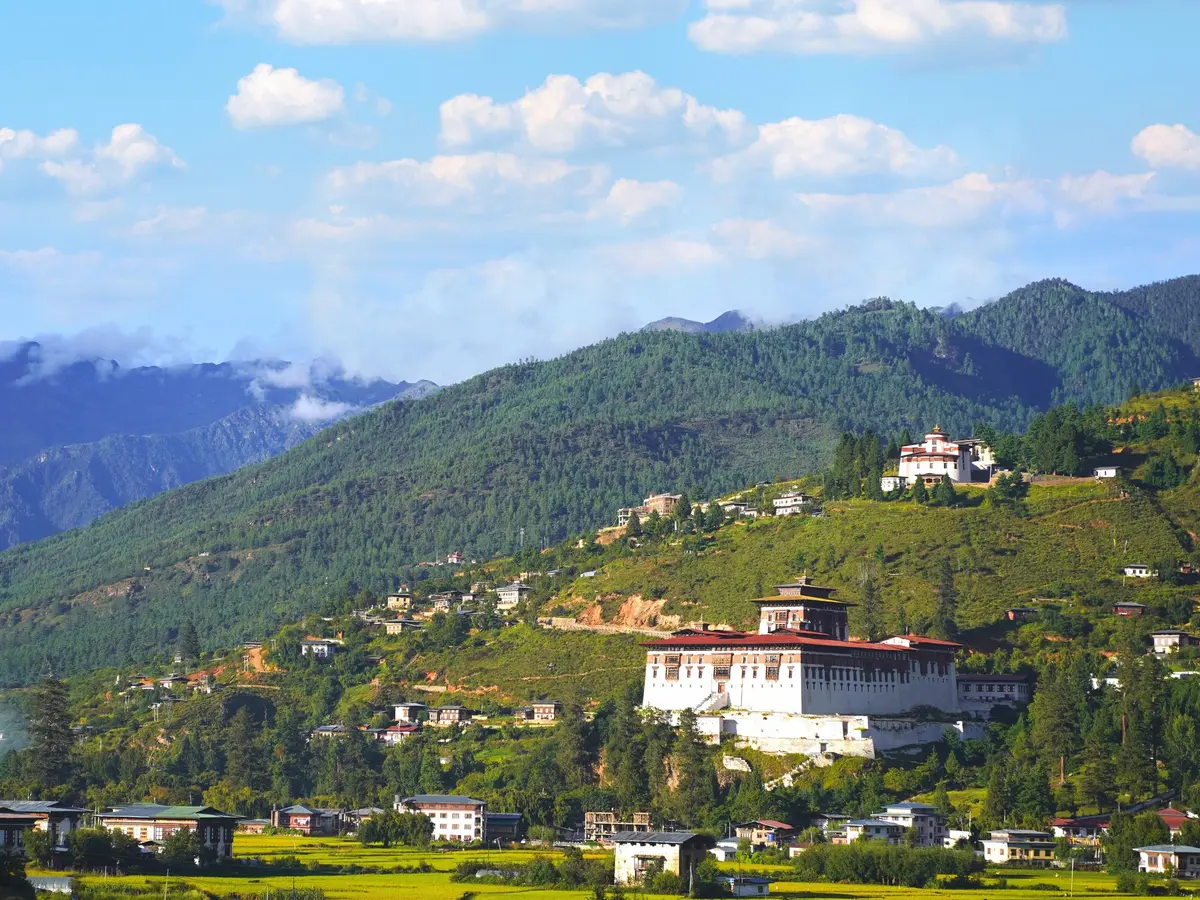
Tourism began in 1974, timed to the coronation of the Fourth King, Jigme Singye Wangchuck. The first paying group — 14 tourists (eight Americans, five Spaniards, one Argentine) — arrived on October 3, 1974, organized by pioneering operator Lars-Eric Lindblad, entering overland via Phuentsholing at a daily tariff of USD 130 per person. The first year saw 287 tourists in total, and Bhutan adopted its "High Value, Low Volume" philosophy from the outset.
Growth was slow and deliberate. The Bhutan Tourism Corporation, a government body, ran the entire industry until privatization in October 1991. Arrivals reached 2,850 in 1992 and 7,158 in 1999. By the late 1980s, tourism was already contributing over USD 2 million in annual revenue.
Milestones from the era: Drukair was established in 1981, with inaugural flights in 1983 (Paro–Kolkata). The first Japanese tourists and the first trekking group (Germans, on the Druk Path) both arrived in 1976.
Era 2: The Growth Era (2000s–2019)
The Association of Bhutanese Tour Operators (ABTO) formed in 2000, when arrivals stood at about 7,559. The policy was renamed "High Value, Low Impact" in 2008. Throughout this era the Minimum Daily Package Rate (MDPR) governed pricing: tourists paid roughly USD 200 (low season) to USD 250–290 (peak season or single travelers) per night, bundling accommodation, meals, guide, transport, and a USD 65 royalty that went to the government. The last MDPR revision before 2022 came in January 2012, when the rate rose from USD 200 to USD 250.
The volume curve steepened dramatically in the mid-2010s as regional (mostly Indian) arrivals surged: 209,507 total in 2016 (+35%), 254,704 in 2017, 274,097 in 2018, and the record 315,599 in 2019. In 2018, regional arrivals of 202,290 were 94.83% Indian and 5.17% Bangladeshi.
Employment and capacity at the 2019 peak: an estimated ~50,000 Bhutanese engaged in tourism (about 15.63% of the labour force, per the sector's own estimate); 3,020 registered tour operators; 4,500 licensed guides; 309 certified accommodation providers. Pre-pandemic, tourism was estimated to contribute ~9% of GDP.
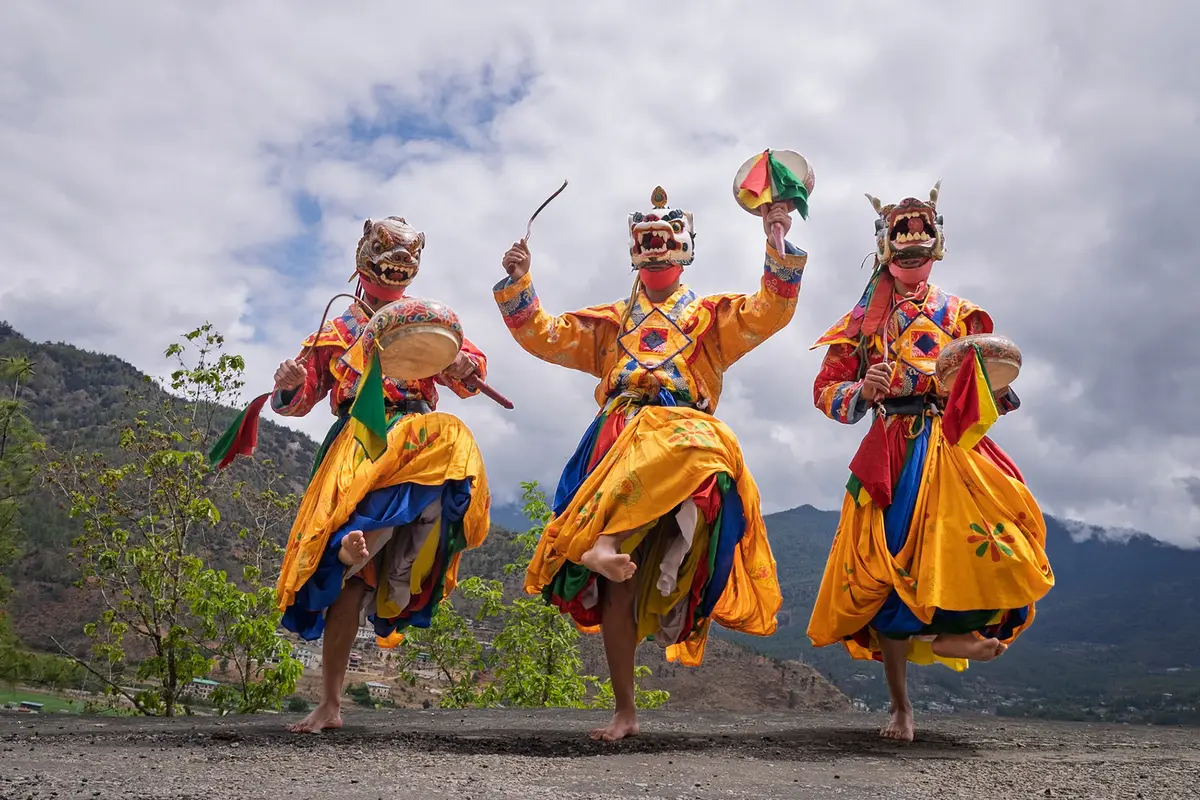
Length of stay and seasonality: the national average stay hovered around 7 nights. Swiss visitors stayed longest (~11 nights), followed by French (~9.4) and Dutch/German (~8.9) travelers. Peak months are spring (March–May) and autumn (September–November), aligned with the great Tshechu festivals — Thimphu Tshechu is the most visited of all.
Era 3: The Record Peak (2018–2019)
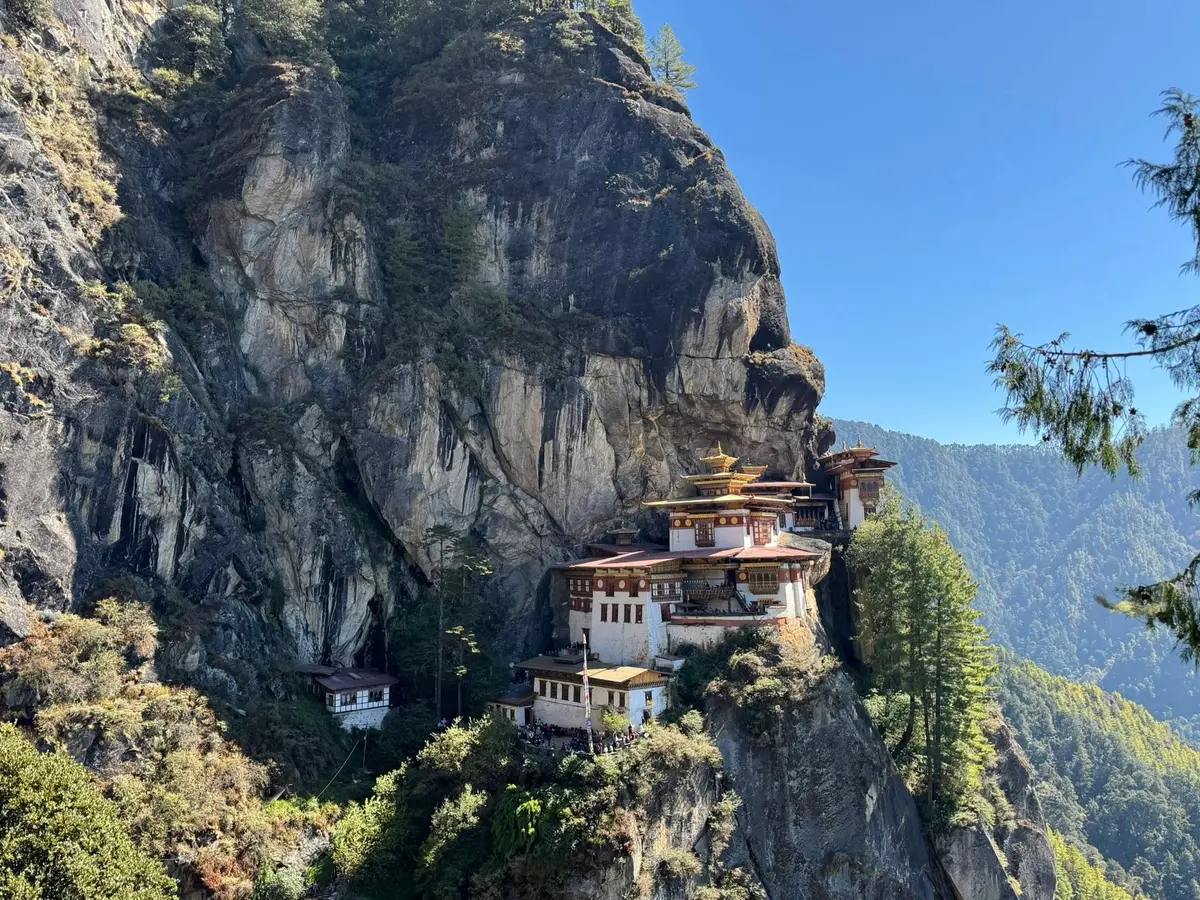
2019 is the benchmark against which all recovery is measured: 315,599 arrivals (72,199 international + 243,400 regional) and USD 88.63 million in gross dollar receipts. Of 2018's USD 85.4 million total revenue, USD 26.3 million was direct government revenue from the royalty, visa fees, and taxes. World Bank receipts-basis spending peaked earlier, at USD 153 million in 2017.
Era 4: The COVID-19 Closure (March 2020 – September 2022)
Bhutan reported its first COVID case on March 6, 2020 and imposed a travel ban almost immediately. GDP contracted 10.1% in 2020 and 3.7% in 2021. Arrivals collapsed to roughly 29,800 in 2020 (World Bank basis) and effectively zero in 2021 — the only sustained gap in the entire 52-year series.
Bhutan used the shutdown productively: restoring the ~250-mile Trans Bhutan Trail, upgrading tourism infrastructure, building digital visa and payment systems, and preparing a full national rebrand.
Era 5: Reopening With the USD 200 SDF (September 2022)
The Tourism Levy Act of Bhutan 2022 (passed June 24, 2022) abolished the MDPR and raised the Sustainable Development Fee from USD 65 to USD 200 per person per night. Bhutan reopened on September 23, 2022 under the new "Bhutan Believe" brand. Regional tourists (India, Bangladesh, Maldives) pay a concessional fee of Nu./INR 1,200 (~USD 15) per night; children aged 6–12 get a 50% discount and younger children are exempt.
The statistical verdict was blunt: between September 22, 2022 and September 21, 2023, just 83,599 tourists visited (57,707 regional; 25,892 from other countries). The USD 200 fee, layered onto a market still recovering from the pandemic, throttled demand.
Era 6: The SDF Cut and the Rebound (September 2023–2025)
Effective September 1, 2023, the government granted a 50% discount, cutting the effective SDF to USD 100 per person per night, valid until August 31, 2027. A 24-hour SDF waiver for border towns (Phuentsholing, Samtse, Gelephu, Samdrup Jongkhar) continues, and qualifying MICE events can obtain waivers.
| Year | Total Arrivals | % of 2019 Peak | YoY Growth | SDF / Revenue |
|---|---|---|---|---|
| 2023 | 103,066 | ~33% | — | ~USD 57M receipts |
| 2024 | 145,065 | ~46% | +40.7% | ~USD 29M SDF |
| 2025 | 209,376 | ~66% | +44.33% | USD 43.31M SDF |
2024: India led with 94,280 arrivals (65%), followed by the USA, China, Singapore, UK, Germany, Malaysia, Australia, Taiwan, and Canada. A sharp Q4 surge brought 49,160 arrivals and lifted quarterly SDF revenue to ~USD 12.1M. The year also marked the golden jubilee — 50 years of Bhutanese tourism — celebrated with the country's first tourism awards and the conferring of the Druk Thuksey Medal on the industry by His Majesty the King.
2025: 209,376 arrivals (+44.33%) from 157 countries. India accounted for ~62% (130,299 nationals), with all other countries contributing 79,077 (up 55.7%). Top markets: India, USA, China, Singapore, UK, Malaysia, Bangladesh, Germany, Australia, Thailand. SDF revenue reached USD 43.31 million (Nu ~3.95 billion), up 49.1%, per the Department of Tourism's Tashel Melong 2025 snapshot (released January 23, 2026). August 2025 alone saw 10,010 arrivals (+96.6% year-on-year). As of August 2025 there were 3,056 registered guides and about 2,800 tour operators.
Era 7: 2026 Year-to-Date
From the Department of Tourism's Monthly Tourism Bulletins:
- February 2026: 9,539 tourists
- March 2026: 26,092 tourists — growth continued but slower than hoped
- June 2026: 25,195 tourists — more than double June 2025's 11,524 — with a striking inversion: 17,814 came from countries other than India versus 7,381 from India. Phuentsholing was the busiest gateway (16,135 entries) ahead of Paro airport (6,979), and Maharashtra was the top Indian source state.
- H1 2026 (consolidated, released July 2026): 149,141 arrivals January–June — up 48.14% (+48,463) on H1 2025's 100,678. May was the standout at 47,343 arrivals — the busiest single month in Bhutanese tourism history, nearly a third of the half-year total, followed by April (30,345) and March (26,092). India contributed 107,775 H1 visitors, followed by the USA (6,190) and China (3,791). Phuentsholing was the dominant gateway with 87,440 entries — about 58.6% of all arrivals — underlining how overland travel from India powers the volume story.
- Spring headwind: the Middle East conflict disrupted the Paro–Dubai route (Drukair suspended flights March 2–17, 2026); 79+ tour groups reportedly withdrew and some luxury resorts saw steep spring declines — which makes the June rebound especially significant.
- Policy changes: a 5% GST on tourism services took effect January 1, 2026 (the SDF is explicitly exempt and remains USD 100/night); since GST replaced the prior 10% hotel sales tax, the net trip-cost increase is roughly 2–4%. Drukair added up to three weekly Paro–Singapore services from April 2026 and launched a subsidised airfare scheme for SDF-paying tourists.
Government Targets and What Comes Next
- The stated goal is a return to 300,000 arrivals — 2019 levels. Prime Minister Tshering Tobgay has signaled that if demand exceeds that threshold, the SDF may rise again; the Commerce Ministry insists the model stays "firmly rooted in a commitment to a high-value, low-volume approach."
- Interim targets have been a mixed bag: 150,000 for 2024 (roughly met at 145,065) and 250,000 for 2025 (missed at 209,376).
- Long-term frameworks — the Bhutan Integrated Tourism Master Plan 2025–2034, the 21st Century Economic Roadmap, and the 13th Five Year Plan (2024–2028) — identify tourism as a central economic pillar targeting a 10–15% contribution to GDP by 2050, with Gelephu Mindfulness City emerging as a flagship draw.
- The SDF discount is scheduled for review before August 31, 2027 — the single most consequential upcoming policy date for anyone planning around Bhutan travel costs.
How Bhutan Compares With Its Neighbors (2024)
| Country | 2024 Arrivals | Model |
|---|---|---|
| Bhutan | 145,065 | High value, low volume; USD 100/night SDF |
| Nepal | 1,147,567 | Volume-driven; 96% of pre-pandemic level |
| Sri Lanka | ~2.05 million | Volume-driven |
| Maldives | 2,046,615 | High-value resort; record year |
Bhutan receives less than an eighth of Nepal's visitors — by design. The kingdom deliberately caps volume and prioritizes per-visitor revenue and cultural and environmental preservation (the constitution mandates 60%+ forest cover in perpetuity). It is a fundamentally different strategy from every neighbor.
The High-Value vs. Volume Debate
The core tension is Gross National Happiness versus Gross Domestic Product. Proponents argue the SDF funds free healthcare, education, and carbon-negative conservation. Critics — including many tour operators — argue the USD 200 fee was set too high at the worst possible moment, and that even at USD 100 too much revenue leaks offshore. A January 2026 Kuensel investigation found foreign travel agents control key booking segments, with Bhutanese guides working through Indian operators in Jaigaon earning Nu 1,800–2,000 against the Nu 3,000 minimum daily allowance — rising arrivals, shrinking local returns. That is the central unresolved question heading into the 2027 SDF review.
What the SDF Means for Your Trip (2026)
- Most international visitors: USD 100 per person per night, through at least August 31, 2027
- Indian nationals: INR/Nu 1,200 per night (~USD 15)
- Bangladeshi nationals: USD 15/night for the first 15,000 arrivals annually
- Children: 50% off ages 6–12; under 6 exempt
- Border-town day visits: 24-hour SDF waiver in Phuentsholing, Samtse, Gelephu, and Samdrup Jongkhar
- New in 2026: 5% GST on tourism services (SDF exempt); net cost impact roughly +2–4%
Data Notes and Caveats
- Source discrepancies exist. World Bank and UN figures are rounded and can differ from Tourism Council of Bhutan counts (the 2019 total appears as 315,599 officially but ~316,000 in secondary sources). This page privileges TCB/DoT figures.
- "Arrivals" definitions vary. Some counts include all visitors; others separate dollar-paying international from regional. Bhutan itself notes there is no comprehensive data on revenue from regional tourists.
- Revenue figures are not directly comparable across years — the fee changed (USD 65 → 200 → 100) and reporting bases differ (gross receipts vs. SDF-only). Treat cross-year revenue comparisons as directional.
- 2026 full-year figures remain provisional; the H1 2026 total (149,141) is the Department of Tourism's consolidated half-year figure released in July 2026. Minor discrepancies exist between sources in monthly comparison bases (e.g., June 2025 reported as 11,524 vs. 13,671; H1 2025 as 100,675 vs. 100,678).
- Employment and GDP shares are estimates, including the minister's 10–15% GDP remark and the ~50,000-jobs figure.
- Targets are goals, not achievements — several interim targets have already been missed.
How to Cite This Page
If you reference this data in research, articles, or reports, please cite the underlying sources:
- Arrivals and SDF revenue (2023–2026): Department of Tourism, Royal Government of Bhutan — Monthly Tourism Bulletins and the Tashel Melong 2025 annual snapshot (January 2026)
- Historical arrivals (1974–2019): Tourism Council of Bhutan Annual Tourism Monitors
- COVID-era and receipts data: World Bank; national GDP releases
- Policy and industry reporting: Tourism Levy Act 2022; BBS; Kuensel; The Bhutanese
- Regional comparison: Nepal Tourism Board; Sri Lanka Tourism Development Authority; Maldives Ministry of Tourism
The interactive chart above is free to embed with attribution to bestbhutan.com. This page is updated as new bulletins and annual reports are published.
Planning a trip and want to put these trends to work? The data says book spring and autumn festival windows early — contact us and we'll design an itinerary around the best seasons, regions, and value for your dates.